Maybe it’s Sky’s editorial policy, but it took their commentators 53 minutes to mention Rob McElhenney and Ryan Reynolds by name last night. Up until that moment, they were simply referred to as ‘the owners’; a constant presence floating on the thermals of the ether.
It’s easy to criticise McElhenney and Reynolds for juicing the system with their millions in order to catapult Wrexham from the Conference to The Championship at an unnatural speed, but they come across as genuine, compassionate people who bring more good into the world than bad.
The thing that really endeared them to me was McElhenney’s discovery of English football, and specifically, the joys of promotion and relegation. Maybe somewhere deep inside it resonated with the ideals of the American Dream, something that’s oddly absent in American sport, which, to paraphrase sociologist David Harris, is a socialist system run by billionaires and watched by capitalists.
The American Dream is the idea that you can be successful through merit and effort alone. There’s one problem with this; it doesn’t work, rich people always have their thumb on the scales. For every working-class American that makes it to the top of US sport or entertainment – a typical rubric of success – there are millions more who don’t and never will. Americans are constantly sold the idea that they just have to work harder to be successful. But, when they work harder and nothing changes, the frustration of working without reward will eventually blow, if it hasn’t already.
In Britain, we’re much more conscious of the class system that stratifies us, which is equally wrong and unfair, but at least offers a mental model within which it’s possible to function. In short, if you don’t expect much and don’t get much, then you’re probably going to be less disappointed than if you expect everything and get nothing.
The Football League is a mix of the two ideas – there’s a class system; clubs are divided into groups with their own character and status and most have a ‘natural level’. On the other hand, in theory at least, you can buy a football club in the National League and go on to win the Champions League; the American Dream.
Except, this isn’t how it works. There’s a degree of mobility within your natural level, but there’s always a ceiling to what you’ll ever achieve. You have to be state sponsored (PSG, Newcastle, Manchester City) if you want to be part of the elite. This is the choice that McElhenney and Reynolds now face, in the early years of their ownership, the story was of good things happening to good people. Now they’ve crashed through the ceiling of their natural level and they face a dilemma as to whether they keep going, breaking the social contract, or stop and accept reality and lose their narrative. Whether either option makes good television or not, remains to be seen.
Oxford faces similar issues albeit without the veneer; some say that the Championship is our natural level because that’s where they grew up watching football in the 1990s. However, since we entered the Football League, we’ve spent less than a third of our time in the Championship and two-thirds below the second tier. Without something to tip things in our favour, our natural level is somewhere around League One.
Of course, the idea is that we’re putting in place the building blocks to establish ourselves, at least, as Championship regulars. But, it’s a programme which is over a decade in the making and has at least two more years to run. Until then, we’ll always be subject to the gravitational forces of nature.
As a result, after the encouraging display against Derby, a slump wasn’t wholly unexpected. It did, at least, confirm to Gary Rowett that keeping a winning team is not a valid strategy when the same eleven can dominate in one game and capitulate three days later.
As always, Sky’s coverage was underwhelming, I find myself watching out of duty rather than genuine entertainment. The commentary was OK but the crowd sounded like a disinterested Conference rabble, a long way from the Disney-fied Racecourse ground featured on the documentary where the place pulsates with emotion punctuated by raw releases of communal joy.
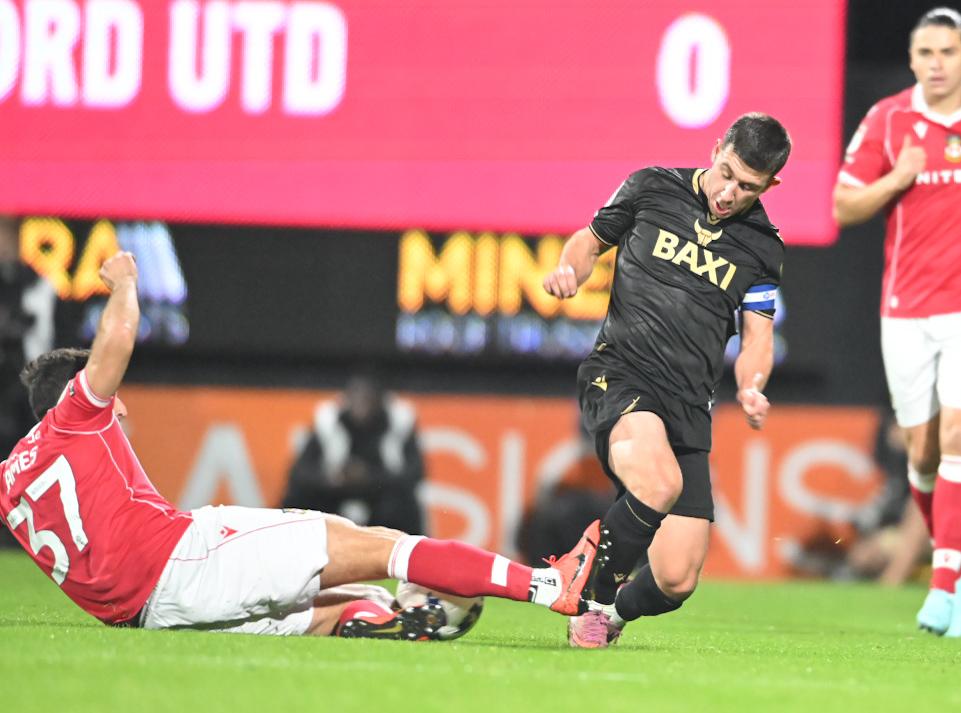
It didn’t take long to realise that the real Wrexham are just like us, scrabbling for a foothold in an unfamiliar division, trying to find a rhythm. The opening exchanges were agricultural, the ball pinging around with a notable lack of control.
It’s times like this that you need your leaders like Cameron Brannagan to grasp the nettle and set the tone. The tone he set was to drill a stinging back pass to Jamie Cumming which required the keeper to parry the ball for a corner. Cumming got to his feet with wide-eyed shock, you suspect Billy Turley would have chased Brannagan out of the ground with a loaded shotgun.
The referee deemed it a deliberate back-pass (deliberate in the sense that he couldn’t have hit it harder), and while the rule is unforgiving – anything that’s kicked to the goalkeeper that results in them using their hands is prohibited – an indirect free kick 12 yards out was a disproportionate punishment for what was a comical error.
Having survived that, the farcical opening continued up to the goal a few minutes later. A corner was delivered in to Keifer Moore who scuffed it back to Nathan Broadhead through a sea of static defenders. Cumming seemed slow to get down to Broadhead’s shot and couldn’t keep it out. It was ultimately the accumulation of sloppiness throughout.
The game continued in that vein throughout the first half. They didn’t so much threaten as grind away waiting for us to make a mistake. On a different day, we might have survived without conceding, on another we may have conceded more.
The good news at the break was that we couldn’t really have been much worse while they didn’t seem able to get much better. We seemed to start building some momentum until Doyle was sent off on 67 minutes for a wild challenge of Dembele. Rather than giving us an advantage, it further reduced our prospects as they had no reason to take risks while we had no guile to unlock their rearguard.
Moments were fleeting, Lankshear could have converted De Keersmaecker’s swinging free-kick while Cumming used his muscle memory from Brannagan’s apparition to parry Smith’s shot in the closing minutes.
It was better in the second half without ever being great, on another day we might have come away with a point, with a bit of fortune, maybe more. We might dream of a different future, but his is our reality now, we’re not a side likely to sweep everyone away, we’re fighting to stay at the top of our natural level. Inconsistency and frustration is normal but we’ll always be better facing the challenge we’ve got than wishing it was something different.


 Oxblogger
Leave a reply to maintenantman Cancel reply