I woke up on Saturday morning at an unreasonable hour following an anxiety dream. In it, I’d been chasing my niece around the Empire State Building because she’d decided to ‘go and play Annie’ while her mum completed a shift in ‘New York’s branch of Waitrose’.
On reflection, the dream wasn’t unexpected. On Saturday I was to face my most enduring football anxiety; a trip to St Andrew’s. I’d been before, sort of. I travelled up to watch our title decider in 1994, got stuck in traffic, locked my keys in the car, was confronted by a gang of kids who said they were happy to ‘look after’ it and phoned my mum from the payphone in a sticky floored pub within earshot of some gnarly faced, drinkers who growled at each other menacingly. Suffice to say, I didn’t get into the ground that night. The longer version of this story is here.
It wasn’t my only traumatic Birmingham encounter. In 1998, we were obliterated 7-1 at The Manor, a disproportionate punishment for Oxford’s players trying to lighten our relegation worries by wearing Christmas hats during the warm-up. Afterwards, I was driving back and got sideswiped by a Birmingham fan who was in the right-hand lane of a roundabout, trying to turn left. He cut inside me, clipped the rear of my car and ran me off the road. He’d passed his test a couple of weeks before and was driving on his own for the first time.
Then, of course, there’s now. Two games, no points, and facing a newly enriched City while hobbled by a troublesome left-sided central defender problem. A very specific, but critical issue.
Incidentally, I blame David Beckham for this kind of micro analysis; before the drama of him nearly missing the 2002 World Cup because of a broken metatarsal, a part of the body we used to call ‘the toe’, people didn’t obsess over such minutiae.
Anyway, I set off with some trepidation; at Banbury the traffic slowed to a near standstill and part of me hoped would become a 10 hour hold up causing me to miss the game. On the M42 a police car appeared from nowhere weaving in front of the traffic telling us to slow down. Eventually it came to a halt, an officer jumped out, ran over to a man walking down the hard shoulder, which was in use, and dragged him into his car before shooting off.
As we got to Birmingham, I started to think about how much the world had changed in the intervening 30 years. I’ve been to Birmingham before and liked it, perhaps my anxiety was unfounded and my previous experiences a thing of the past.
Then I swung into a side street where our pre-booked parking was. The car park was in a community centre, but it was as close to a ghetto as I’ve seen in the UK. When the parking attendant said he’d scanned my number plate, I wasn’t entirely sure he didn’t mean he was preparing for it to be stripped for parts.
If you want to see what a bankrupt council looks like, don’t go to the city centre, go to its outer edges. It was full of food wholesalers and garages with the carcasses of a car wrecks inside. The streets were covered with domestic and industrial litter and abandoned furniture. This isn’t vibrant multiculturalism, the area contains mostly muslim migrants and it would be easy to assume the mess was their fault, but they haven’t got a chance, they’ve been abandoned, dumped out of sight. Because most people don’t see it, there’s no incentive to help. When a council has no money, these are the areas which feel the cuts most because, politically, these people don’t matter. It’s morally repugnant as well as economically and socially illiterate, unless you’re funded by billionaires and thirsty for power in which case the victims are easily portrayed as the perpetrators.
At the centre of it all is St Andrew’s. Ultimately all fans are the same, but as a club Birmingham City are perhaps one of the most deluded. If you watch their 1994 documentary, The Manageress, you’ll hear David Sullivan talking about their rich history and how they’re a sleeping giant that needs a 60,000-seater stadium. They have similar ambitions now they’ve been engorged again, this time with cash from American investor Tom Wagner and his Knighthead Capital investment firm. These are grand statements, despite what is ultimately an unremarkable history of non-achievement spent mostly in the shadows of more successful local rivals.
As a result, it’s almost that they don’t know how to use the gift they’ve been given. On entering the ground, you’re deafened by a DJ mix of wedding staples which have been remixed into a thumping EDM style. If you heard it on a night out, it’s the kind of music which really makes you feel like you’ve walked into the wrong club.
St Andrew’s is now Knighthead Park or to be grotesquely accurate ‘St Andrew’s @ Knighthead Park’ cementing Wagner’s occupation of the club. There’s clearly a drive to turn it into a ‘hard place to come’ and a bear bit of intimidating energy.
To be fair, it works, these are good times for Birmingham, there’s clearly a forward momentum. The atmosphere was rousing, Oxford fans responded, there were fireworks, by kick-off things were getting freaky.
Playing them is like being attacked by a swarm of wasps, there’s no doubt they have the ability to hurt you, but there’s not much finesse. With the right equipment, you can probably tame them.
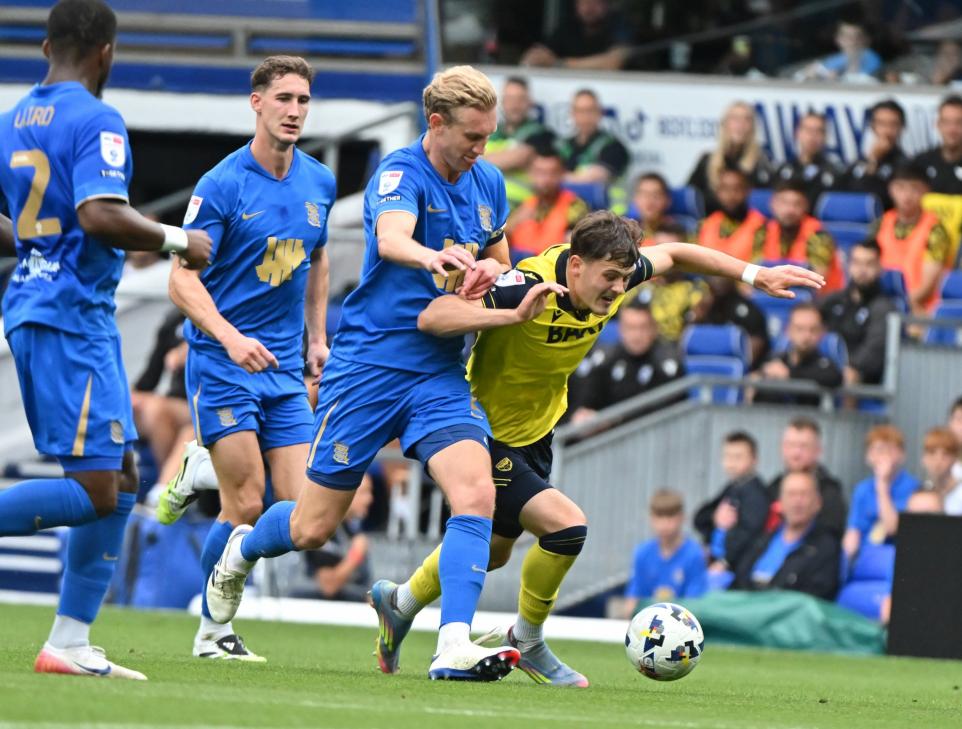
We started solidly enough, Brian De Keersmaecker’s debut gave us structure in midfield while Sam Long in defence felt more assured and balanced than we’ve looked this season. We were able to take the energy out of the game, looked to be in control and even fashioned a chance or two. They threatened in parts; Demarai Gray was all liquid and florid on the wing while Furuhashi went close a couple of times. But it was nothing you wouldn’t expect from a home side with tens of millions of pounds pumped into them.
As we entered the danger zone – immediately before and after half-time – it felt like we might be able to wrestle the beast down. The home crowd seemed to have burnt themselves out, which was reflected by a loss of effervescence on the pitch. Then, we switched off and Paik Seung-ho fired in the most routine goal we’ll concede all season.
The second half created little drama. Tactically, we made sense. Someone near me shouted ‘can you at least try to attack?’ but swatting at the wasp nest would just draw out their anger. There was logic in containment, the introduction of Shemmy and Stan Mills stretched them, but where Placheta has the pace and Mills the delivery, we need a combination of both if we were going to provide more than half-chances.
The final whistle went with us protesting about a corner and them cheering with a degree of relief. It was closer than I’d expected, and therefore better than I’d expected. Maybe we left it too late to cut loose, but the damage, ultimately was far less than my anxieties had assumed. The problem is that in a division in which player investments in excess of £10m are not uncommon, there are precious few opportunities to turn that kind of performance, as solid and disciplined as it was, into points. Unlike Birmingham, we can’t spend our way out of this problem, so we need to find a guerilla spirit, something a bit ugly and odd to dig our way out.


 Oxblogger
Leave a reply to Dean Cancel reply