Between the Sheffield United and QPR games I was in Spain at a conference. Having done this for many years, despite everyone assuring you that the pace of change is accelerating to the point where your eyeballs are drying out, the underlying messages in most presentations remain the same.
One presenter asked delegates to answer a question using an app which created word cloud on the screen. In a sea of truth words was one giant, bold universal truth: ‘communication’. It reminded me of a video series I once tried to make where we asked conference delegates their golden rules of management. Rather than a range of insights we got twenty people saying their key tip was either ‘communication’ or ‘teamwork’.
To convert these common messages into something new, a favourite tactic is to wrap it in a narrative. Last week compared management to gardening, five ‘love languages’ and the Argentine tango.
Given my propensity to use them in this blog, I’m surprisingly resistant to being spoon fed a tortuous and barely credible analogy. That said, the message of Trust, Agility, Naturalness, Guidance and Ownership (TANGO) has stayed with me in a way a longwinded academic thesis never would.
Oxford United’s season has revealed the tension between what we’re delivering and the way we deliver it. Inverting the Triangle, the book about the history of football tactics puts it starkly; fans go into games with the intention of winning, managers set out to not lose.
Our promotion last year was an objective wrapped in a the most perfect narrative, Des Buckingham’s messianic return to his hometown club, Josh Murphy’s redemption story arc, the reward for Cameron Brannagan’s loyalty. Everywhere you looked, there was a narrative. The way we achieved promotion was almost more important than what we achieved.
This is important, we support football clubs because they contain a narrative about who we are. It might be because it represents where we were born or live, it could be in memory of family, friends and loved ones, it might be the sense of struggle and adventure, it could be your constant in an unpredictable world. Winning games is often a long way down the list of reasons you turn up every week.
The narrative carried into the new season, even when we were serving up toothless defeats at QPR and at home to Middlesbrough there was still a sense that the wrapping was more important than the result.
It’s easy to become consumed in the narrative; I once saw a conference speaker deliver an entertaining presentation on generational differences in the workplace. In truth, it was little more than a stand-up routine with tired tropes about Gen Z having the attention span of a gnat and the cynicism of Gen X. There was no insight, it was all wrapper and no result.
By accepting our lot, slipping down the division, we were becoming consumed by the narrative. Gary Rowett’s arrival cast aside the wrapper, which is a bitter pill to swallow and, perhaps, one which has been administered too callously at times. It implies the narrative we’re so invested in is trivial and disposable, that we’re arcane and naïve in a business which demands results.
Whether what’s emerged is just regular RowettBall or that he has so little confidence in the squad he’s unleashed UltraRowettBall remains to be seen, but he’s certainly cast aside many of the things we believe to be true about being a football club.
That said, he isn’t the first to marginalise Sam Long.
It’s understandable that any new manager will want to make their mark; adopting the tactics and players of your predecessor hardly represents a message of change and renewal.
Sam Long has been through this with eight managers since his debut in 2013. Each time, he’s been set aside as part of the old way of doing things, each time he has eventually shown his value. In their moment of most desperate need, Sam Long has delivered.
He’s not a disruptor; you get no sense that he’s in a rush to chase a payday elsewhere or demand that everyone recognise his qualities. He’s part of the furniture, a good guy to have around, a constant in a world of continuous change.
We’re often drawn to new and shiny things and spend too much time focussing on the failings of what we have. There are plenty of fans who say that Long isn’t a Championship player despite the fact when he’s been called on, he’s performed with dedication and application.
In part, proof that Long isn’t a Championship player is based on a torrid night against Burnley back in February. That was his last start in an Oxford shirt before Saturday. On Wednesday, despite the loss of Ciaron Brown and Hidde Ter Avest, Rowett kept Long on the bench. For the visit to Hillsborough, his hand was forced.
We might have tried to convince ourselves that Sheffield Wednesday were a club in crisis, but after the performance against QPR, it was still hard to see us coming away with the points we needed. We probably benefitted from the fact they’re disengaging with the season, being comfortably mid-table. Their players will inevitably be distracted by their evident financial problems and be thinking about what they might do this summer. It might only impact 1% of their game, but it seemed to be enough to level the playing field.
None-the-less, we had our own distractions, relegation is its own gravitational force, it’s easy to panic once it’s luring you in, one glance over your shoulder and you can easily be wiped out by what’s in front of you.
As the game progressed, it became clear a point was within our grasp. The forces being on exerted on both clubs were balancing each other out. We threatened in parts, as did they, the time drifted towards the hour mark, the game teetered.
With eleven minutes to go the ball went out of play and UltraRowettBall was engaged. Will Vaulks wiped the ball on his shirt preparing to hurl another chaos bombs into the box. Vaulks’ long throws aren’t analogous of Rowett’s ruthless focus on results, they’re the evidence.
The ball arced high into the sky following its familiar trajectory. His sermon of truth dropped, Wednesday’s defence panicked, given everything that’s going on, this was the last thing they needed.
Callum Patterson, Akin Famewo and Svante Ingelsson went for the same ball, beating Helik but creating a new chaos. Famewo rose highest, the ball sailed towers the back post, exactly where Sam Long was lurking.
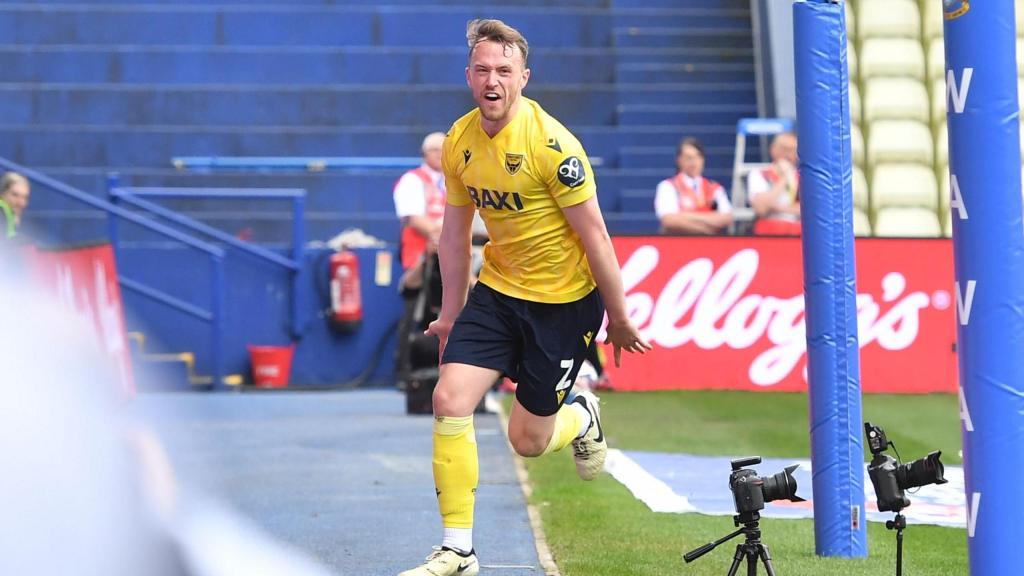
The narrative of the club is embedded in Long, his recovery from injuries, the devastation of the play-off defeat to Wycombe, our emergence as a modern, stylish football team under Michael Appleton and our promotion under Des Buckingham. These and other memories are all baked into him. Finally, Rowett’s ruthless focus on results met the narrative that we’re all so invested in. Long grappled with his marker, lunged into the space beyond the keeper and directed it into the net.
The most unassuming player had delivered the season’s pivotal moment. He may be part of the fabric of the club, and almost invisible as a result, but the goal could and should be one which keeps us up. And if that’s worth £10m and Championship football leverages the decision to approve the stadium, then by every measure, Sam Long is priceless.


 Oxblogger
Leave a reply to David Kirby Cancel reply