
Coincidentally, this week I’ve finished reading Together Forever, the story of Elton John and Graham Taylor’s relationship during their time together at Watford in the 1970s and 1980s.
The book isn’t a technical analysis of Taylor’s success with Watford which took them from the Fourth to the First Division and an FA Cup Final in 1984. It’s about the unlikely intersection in the Venn diagram of Taylor and John’s lives, which otherwise couldn’t have been more in contrast with each other.
It does, to some extent, re-write Taylor’s managerial history. The author describes Taylor’s football in heroic terms, which to Watford fans it was and still is.
Taylor was a product of his times, with no money and a host of other problems, football was utilitarian. Taylor was already an obsessive disciplinarian before he recruited ex-Arsenal manager Bertie Mee – a man who insisted players wore suits to training – and the notorious Charles Reep.
Reep was an accountant and amateur statistician who calculated that most goals were scored after less than three passes. It spawned a generation of managers – Taylor, Dave Bassett at Wimbledon and Howard Wilkinson at Sheffield Wednesday – who committed themselves to building teams that got the ball into the box as quickly as possible. Also known as The Long Ball Game or Route One. Gareth Ainsworth is its lovechild.
There were flaws in Reep’s analysis, it didn’t account for the benefits of keeping possession such as pulling teams out of shape or winning set pieces. And, it didn’t have any control data – you could score lots of goals from direct football, but as was evident in international football, you could score more with a possession-based game. Reep just didn’t have access to that data.
Still, it got results and Taylor set about refining his model by getting his players fitter and stronger and getting balls into the box quicker and with more accuracy. Howard Wilkinson described the entire philosophy as ‘get fit and practice.’
While the long-ball has been largely discredited as an endpoint solution, you suspect that many in the middle of the Championship have adopted some of its genetic pragmatism.
Gary Rowett’s reputation is built on it. On Saturday I looked down at him in his black cap, coat and tracksuit trousers. If you replace the Oxford badge with one from Stoke, Swansea, Preston, Hull or many others, it wouldn’t look odd.
We’ve been in a race to ‘get fit and practice’ since Rowett’s arrival. What’s emerged is a low-risk defensive strategy and an attacking model based around set pieces. In the nine games without a win before the Watford game, seven were drawn or lost by a single goal with the 2-0 defeats to Portsmouth and West Brom both involving late goals.
Taylor’s football had one-dimension which was chiselled to a fine point, likewise, nowadays, Rowett and his kin are in a race to get players faster, stronger and more accurate. What emerges is a sort of high-level low-quality football.
Strangely that’s a contrast to the top of League One, perhaps managers are more naive and less experienced, they coach more than they manage. Perhaps, because the stakes are a bit lower, there’s a bit more space to breathe and more scope to take risks.
Or maybe it’s just because with ten games to go we’re in a cut-throat relegation fight. While, going into the Watford game, we still had a four-point buffer, for many fans it felt like we were a Christmas tree slowly being fed into a chipper.
There are no truly winnable games, but if we are going to survive, then Watford seemed as close as we might get to one. Their dalliances with the play-offs are falling away and they were contrite about having no senior forwards fit or available. Put it another way, if we couldn’t beat them, then who exactly were we planning to beat?
The mood around the place was odd, we’re not yet fully resigned to our fate, nor are we fearful of going down, nor do we seem fully engaged in the fight. We don’t really know who we are. One thing Gary Rowett hasn’t done since he arrived is galvanise the club. He might argue it’s not his role to be the flag bearer, he just manages the team. Perhaps it’s naïve to believe that this is the role of a manager at this level, Watford have had nine managers since the pandemic, it’s a world away from their heyday when Taylor loomed large over everything.
The game followed a predictable pattern, they were strong and assured, we were less strong and less assured. But with a general impotence all-round nobody seemed in a rush to take control of the game.
As predicted, we focussed on territorial gains and set pieces. Corners, free-kicks and throw-ins rally the crowd but each frustrating miss or misguided cross just adds another layer of anxiety and frustration.
It’s hard to know whether we’re just locked into a particular way of playing or fearful of making a mistake. On a couple of occasions Jamie Cumming collected the ball and Shemmy Placheta and Siriki Dembele set off down the wings hoping for a quick break. Cumming, perhaps not seeing them, perhaps ignoring them, opted to roll the ball to one of his centre-backs. Nobody was prepared to be brave or perhaps that’s being coached out of them.
The game was drifting towards the final ten minutes when Shemmy Placheta was pulled back by James Abankwah for a second booking and a red card. Placheta maybe fitful and frustrating, but he’s a constant irritant in a system that abhors individuality.
Did it feel like an advantage? Hard to say, as we saw against Bristol City, Championship sides seem to quite enjoy a red card as it gives them a licence to be less adventurous. The prospect of us breaking them down seemed remote.
But, three minutes later, Cameron Brannagan launched a long ball towards Mark Harris, who got his toe to the ball and was taken out in the process. The referee may have blown for a free-kick, but with the ball at Siriki Dembele’s feet, he let play continue.
Dembele has been symptomatic of our problem, he wants to play and entertain, but in a world of great lumbering beasts he struggles to find an end product. For once he was free to cut in and rifle the ball into the back of the net.
It was as if we’d seen a crack of light in a dark cave, our eyes had become accustomed to the gloom, but now there was a new hope. Dembele arced away in celebration, the rest of the team followed. It was time to slow things down even more; we weren’t here to entertain, winning was too important for that. As the fans settled back into their seats, the players stood by the corner flag holding an impromptu book club meeting or receiving an interesting talk from Will Vaulks about his antique teapot collection in order to run the clock down.
Perhaps we need to accept that, at least until the end of the season, this is the model. The ideology of proper, entertaining football has fallen away in its place is a rawness. It will tie knots in our stomach and make our hearts sink and soar in medically inadvisable ways, but if we can carve out these moments and we survive and then it’ll all be worth it.
While you’re here…
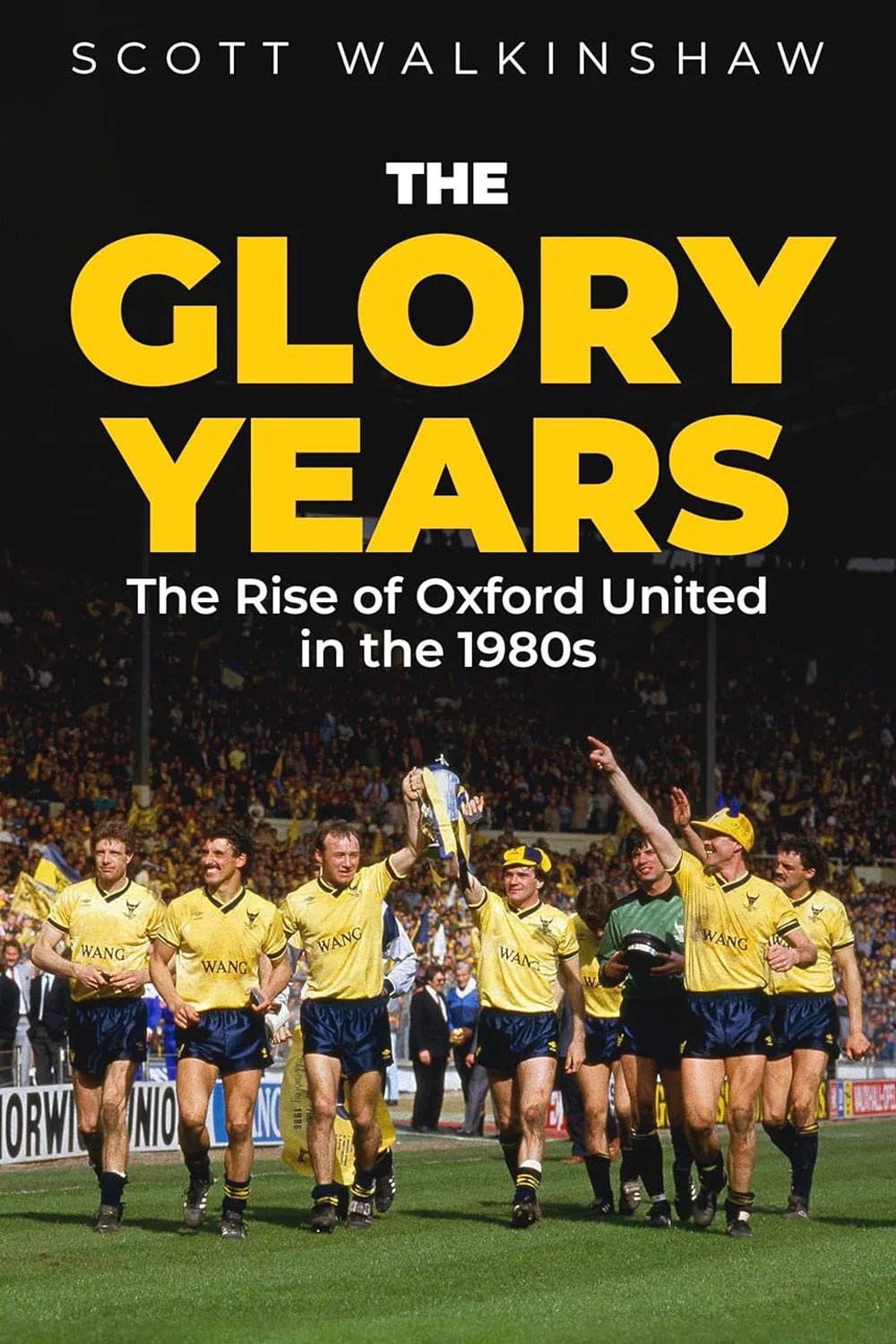
Florence Park Talks brings you a celebration of Oxford United literature as we bring you Mad Dog and The Glory Years… Live!
26th March, Florence Park Community Centre, Oxford, 7.30pm.


 Oxblogger
Leave a reply to Mr Greg David Cancel reply