
There’s an old football idiom that asks ‘…but can they do it on a wet Tuesday in Stoke?’ Mostly, it’s targeted at effete foreigners, as it represents a threshold they need to pass before being accepted into the English game.
It tends to be rolled out when a player or team has success which can be partially dismissed as having the good fortune of playing a poor team or in favourable conditions.
Why Stoke? Well, it’s one of the most deprived cities in the country, was considered the Brexit capital of the UK and, up until the last general election, was represented by the swivel eyed lunatic Jonathan Gullis in the House of Commons. Make of that what you will but it’s not quintessentially English, because most of England is not like Stoke.
Perhaps it’s something about Stoke City specifically who have been a Championship makeweight for the last seven years. During that time their highest finish was 14th, their lowest was 17th, they’ve barely troubling the scorers. They are currently 20th.
It may also be the agricultural football they’re associated with, particularly under Tony Pulis. which brought them relative success during the mid-2000s. It doesn’t take long to get from a conversation about Stoke City to Rory Delap’s intercontinental long throw technique. The press used to salivate at the hex Pulis’ teams seemed to have over the more cosmopolitan (and blisteringly successful) Arsenal under Arsene Wenger.
This all makes for a curious benchmark, far from being the pinnacle of the game, which is illustrated by silverware, medals and caps, it plays to that oddly British idea that you’re not allowed to be good at something until you’ve suffered first. Or, if you are good at something, then you should do all you can to talk it down.
So, a wet Tuesday in Stoke is some kind of gateway to a minimum level of credibility, a bit like being beaten by ‘Teams like Oxford’ is used as the threshold to describe abject failure. So, what does the fact we’ve navigated a goalless draw with Stoke, albeit not on a wet Tuesday, actually mean?
There may be one significance; only two sides in the last ten years have been relegated from better positions than ours. The first is Hull City in 2019/20, the season that was interrupted by Covid in which they conspired to lose seven of their nine remaining games after the resumption. They’d also lost nine and drawn two immediately before that. The other was Reading in 2022/23, not in small part due to a points deduction.
So, while there is still some way to go before we’re mathematically safe, all things remaining normal, we do appear to have reached a level of safety or breathing space which, frankly, we didn’t dream was possible at the beginning of the season. Getting a point at Stoke (wet, Tuesday etc. etc.), to some extent, appears to signal that we’ve reached a Championship interregnum where we’re not the relegation yoyo club we thought we’d be, nor are we an aspirant Premier Leaguers fighting for places at the top.
Time will tell as to whether that is in any way permanent, but look at the teams around us – QPR have spent every one of the last ten seasons in the Championship, Preston have done nine, Millwall eight and Swansea six. These are teams that are not in a rush to go anywhere.
It’s worth saying that each of these clubs have their share of fans grumbling about not really achieving anything. I guess it’s a bit like us in League One over the last couple of seasons, you eventually get tired of the inertia.
But I’m getting to like being one of those clubs, for now, I think it’s OK. I don’t mind having Gary Rowett as a manager or players who will mostly spend their lives working their way around similar clubs in the division. I like the fact that we’re playing teams like Stoke and Preston and have a real chance to do it again next season.
I loved the aesthetic of seeing us in yellow and blue up against them in their traditional red and white, it had echoes of the 1990s. It’s funny because seeing us at this level makes me more conscious of what it means, much more than back then. In the decades to come we’ll look back at players of today as heroes and legends, even if their main achievement is to see us sitting in mid table.
I missed the game due to circumstances which meant I was in London. Although we were heading into the middle of town, we parked at Westfield in White City just as QPR and Sheffield Wednesday fans were beginning to congregate for their own non-event Championship tussle at Loftus Road. It struck me that these are people like us or more specifically, we’re like them. They’re don’t (or can’t) buy into the primary colours of the Premier League, but they’re big enough to have a presence in wider society. We’re not lower-league weirdos forced to explain why we spend our Saturdays going to places like Fleetwood or Morecambe, as enjoyable as that can be. Going to see Oxford play at Stoke or Sheffield Wednesday at QPR has a baked-in credibility which means we’re part of something. The acceptance is new and novel.
Back in 1993, I went to Reading festival and saw Blur headline the second stage. At the time they were has-beens and about to be dropped by their record label, consigning them to the Indie band history books. Most of the bands on the same bill are now no more than wispy memories. Far from succumb to their imminent demise, they ripped the roof off, playing a blistering performance that blew everyone away. It saved their bacon. For the weirdo indie kids packed into that tent, this was their wet Tuesday in Stoke performance.
Less than two years later, Blur played Wembley Arena for a series of Christmas gigs. Parklife had gone stratospheric, Britpop was at its peak, Blur v Oasis had been a thing and Blur had won. It was awful, the phenomenon had consumed the band, the cavernous arena was full of screaming teenagers and tanked-up beer boys sloshing their lager down your neck. We were glad when it was over, because we knew it was over.
A goalless draw at Stoke in which we compete rather than survive and a point we won rather than sneaked will likely be forgotten in mists of time. But, in fact, we should stay conscious to what this means. We’re establishing a platform which we thought was unachievable a few short months ago, we may fall off it, we may build further, or we may stay the same, but we should probably stop a moment and enjoy the view.
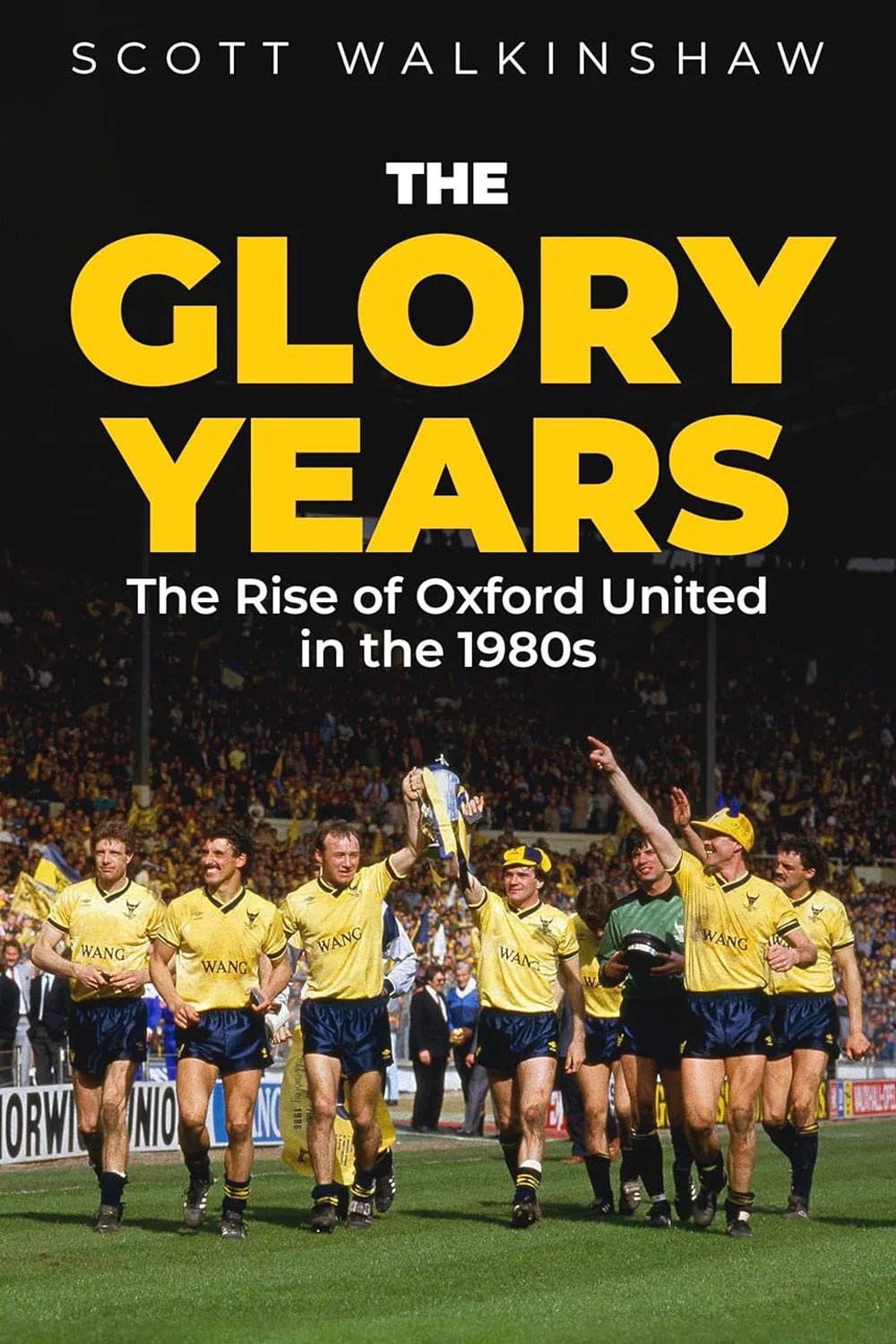
Out next week – The Glory Years
The Glory Years, the story of Oxford United’s rise through the divisions from the verge of bankruptcy to Wembley glory in the 1980s is out next week.
You can buy it now here or it will be in stock at Waterstones in Oxford, Witney, Banbury and Didcot next week.

 Oxblogger
Leave a comment