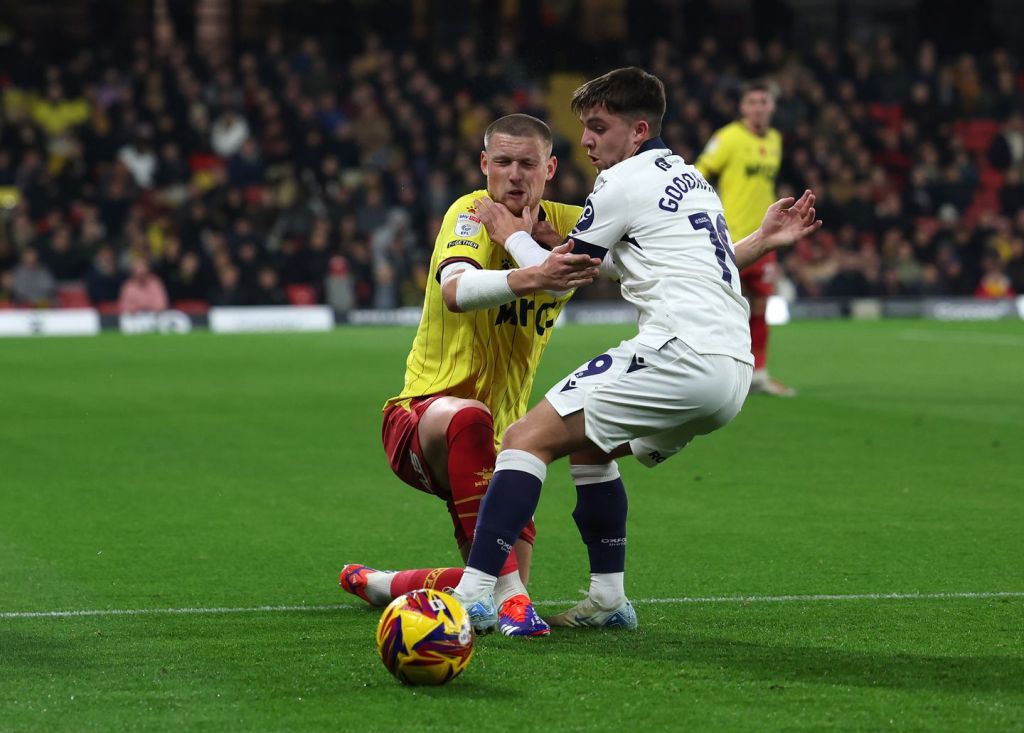
I have three very clear islands of memories of Vicarage Road. The first is from the opening day of the 1986/87 season, we arrived after one season in the top-flight as Milk Cup holders with all the chutzpa of a team that thought it had established itself. John Barnes scored after six minutes, David Bardsley added the second and Luther Blisset the third. Famously Tony Obi got fifteen minutes of fame. Even Brian Talbot was in Watford’s starting eleven enjoying the novelty of winning a game.
The second is from 1997, an FA Cup tie which had already been postponed and was then delayed due to a floodlight failure (which was subsequently fixed by an Oxford fan). We were easily disposed of, but the game was more significant as it marked the first we played after the sale of Matt Elliott to Leicester for £1.6m. It would be another 19 years before we received more for a player, a period in which transfer inflation grew nearly five-fold.
The third was last night, the players stretched out in a line sharing a moment with the fans after a performance of endeavour, application and effort, but no tangible reward.
It’s been over twenty years since I was last at Watford, I remember little of it apart from the Vicarage Road stand sitting flush to the road and the walk via an allotment to get to what was then the away end. As we arrived, those vague fragments reformed into something more whole. The stadium remains familiar but is now clad in the neon finish of modern football. It nestles in amongst the houses and sits as a hub for a micro-economy of pubs and chicken shops which serve fans on a match day. It’s not an enormo-dome of the modern age, but it is precisely where I want football clubs to be – constantly evolving while rooted in their history.
It’s also a reminder that the clubs we’re facing this season are benefitting from years of gradual momentum. Once upon a time, the now Sir Elton John Stand was crumbling and condemned, film of that game in 1986 shows both ends are open, the programme tells the story of the building of the new Stanley Rous Stand (now the Graham Taylor Stand).
We are at the foothills of that journey, having been cryogenically frozen by a woeful lack of vision and ambition. If the Championship experience is anything, it’s a reminder of the failures of not only the club’s former owners, but the authorities who can influence its future.
As we queued for a surprisingly thorough pat-down, in which I shamefully had to empty my pockets to show the steward my keys, phone and a Wispa chocolate bar wrapper, someone behind me said ‘Oh god, please don’t let us be thrashed.’
After a couple of whimpering performances and a slew of injuries, we’re not quite trying to dig ourselves out of a slump, but more trying to avoid an irreversible decline. Most people expected difficult periods this season, most hoped we’d recover from them. Playing Watford, one of the bigger dogs in the division, live on TV, just before the international break was inopportune to say the least. A heavy and humiliating defeat, like Bolton last season and a fortnight to think about it would not have enriched the soul.
Inside were more reminders of the tides we’re swimming against; music pounded from the speakers, hospitality boxes bore down from all corners but there has been nothing more impressive about the Championship than the retina burning qualities of modern day floodlights.
We’re reminded of Watford’s historical foundations – the role of Graham Taylor and Elton John, each with a stand named them. Before the game, they play some Elton John bangers. It turns out I’m at an age where I find that a bit emotional.
We decided to sit in our allocated seat in Row A, it wasn’t quite the front row (that was Row DD, obviously), but it was close. This was a nostalgic nod to the time I caught the match ball from a wayward Gary Linekar pass when we were on the front-row of a Watford v Everton game in 1986. Little did we both know in that shared moment how our respective media careers would pan out.
Being so close to the pitch really brought home the speed at which the game is played. Passes and interchanges are lightening quick. Positions change instantaneously. The reality of the Championship flashing in front of us like a strobe.
But, despite being depleted, we were obviously competing with them. You could sense the rapid eye movement, in a constant state of alert, players were being tracked; blocks being made. This is light years from where we were even twelve months ago.
Time passed slowly, because it always does away from home, but we weren’t uncomfortable. We seemed crisp in our passing and resolute in our defending. It’s interesting that the YouTube highlights don’t feature a single moment from the first half, a sign that this was probably more for those absorbed into the game live than for anyone watching on TV.
The game began to turn in the second half, as the Georgian, Giorgi Chakvetadze, with the sallow look of a man carrying a dark family secret, began to pull Will Vaulks and Josh McEachran around. Chakvetadze played in all four of Georgia’s Euro 2024 games, another reminder that this is not a level playing field. Where we once talked about fading at the end of games, it’s this middle section where the likes of Cameron Brannagan are truly missed.
The goal was hardly the sparkling finish of a team hoping to play in the Premier League next season. With a fraction more luck Jamie Cumming might have saved it, but the rapid turnover that led to it is just not something we have or can easily cope with.
As the Watford fans celebrations died down, Oxford fans upped the tempo and volume of their chanting; a message to the players that spirits shouldn’t be dented by mere setbacks. It was a clarion call, we’ll groan at errors and be sad when we lose, but this season in particular, we are with you until whatever the end may be.
There was a response, our energies were renewed, rather than them seeing us off with more goals or strangling the game, we first engaged with the challenge and then began to exert control. The home fans became more agitated as our volume increased, the tempo thundering from the stands was maintained. Mark Harris had their keeper scrambling from a snapshot, Hidde ter Avest should have equalised from six yards, in the last seconds Harris bicycle kicked over from two yards out.
It came to nought, but the final whistle brought a wave of obvious relief from the home supporters. Their players celebrated not of a job well done, but out of relief. They’d survived.
The Oxford players dutifully made their way to the fans and the fans stayed to greet them, we all shared a moment that felt like an eternity. It was a chance to reflect, not on what we haven’t got, but on what we have.
Shuffling out onto the street in the gloom, I heard a Watford fan say ‘a win’s a win’, an admission at how pleased they were to hear the final whistle. We don’t have the momentum of the decades of a club like Watford, but we do have a shared experience and history. Where my previous Vicarage Road memories marked the beginning of the end of an era, this felt like we’re at the start of one.
While you’re here…
Thanks for reading, if you’ve got this far, hopefully you’ll be interested in hearing a bit more. So, a few things for you to look at:
Sign up to the Oxblogger Podcast – subscribe to our whimsical, rambling podcast for some aural Oxblogger. It’s rarely insightful, but hopefully will while away the hours before something more interesting comes along.
Follow me on BlueSky – I’m not abandoning Twitter, but BlueSky seems like a nice alternative. It’s basically Twitter without the egomaniacal billionaire or the racism. If you like racism and conspiracy theories, stick with Twitter.
Subscribe for free to the Oxblogger newsletter – this is an experiment into the world of fanzines. Fan-written, Oxford United content. It’s still digital-only, but we’ve had two issues and it’s full of interesting things.

 Oxblogger
Leave a reply to Matt Rowson Cancel reply