
Every Sunday, for ten months a year, over the last eighteen years, I’ve woken up early, walked downstairs and made a coffee. Sometimes the sun streams in the window, usually not, the house is silent, nobody will wake for hours, I open my laptop.
Beyond a fragment of a point, I don’t know what I’ll write. Whatever the starting point, it’ll be quickly submerged in a dense indulgent metaphor or over-worked diversion. What comes out doesn’t offer a factual record or technical assessment, it’s just a siphon, a way of getting things out of my head and into somewhere else. The longer I’ve done it, the more absurd it’s got. The more I’ve tried to find a point, the more I’ve realised there isn’t one.
Football makes you angrier and more frustrated than is acceptable in any other social context. It makes you happier and more delirious. Equally, I find it more centring, grounding, reassuring. Whatever your politics, background or ideology; the simple, shared goal of winning a game allows you to believe in people again. However your week has gone, there’s always another game with a familiar routine and the familiar faces of people who don’t judge you. I can’t explain why this is, apart from perhaps that we need to access a wider, primal emotional spectrum than we’re normally allowed. Football is the lightning rod because it’s about identity; personal and social history, geography, culture, family and friends.
But while the confines of this dense ball of shared experience is familiar and comforting, Wembley is vast, it reconfigures your perceptions; getting off the train there were Oxford fans dissipated across the bars, shopping malls and concourses of the stadium complex. Most of the faces were unfamiliar, many weren’t invested but had borrowed a shirt or fashioned themselves a yellow outfit and had chosen to be here. The mood was calm, happy and pragmatic; even those who watch intently hadn’t expected to be here and we’d had just ten days to get used to the idea that we were. We were still processing the unexpected events of the last few weeks.
By contrast, we spoke to some Bolton fans, anxiety coursed through them; the only good play-off was a winning play-off. They’d spent weeks pondering this outcome and refined it to that single point. For them a defeat would cause damaging toxicity, the manager would be sacked. I’d briefly listened to a Bolton podcast that struck a similar tone; they needed to ‘complete the job’; winning was everything.
It was quite a contrast, almost immediately we met with Gingermoods and Jonny Biscuits and shared a bewildered joy of simply being there. Nervous? Yes. But it was a good nervous. A contented nervous. The greater prize; the sense of unity and a bit of pride had been won back. What it was and what it means defies words, but this was the reward.
Existential nausea only briefly passed when I thought about the prospects of penalties or taking the lead and having to hang onto it. Getting promoted was beyond my comprehension – I’m long past judging our value by our league status – but what if the Championship entered the zone of achievability? What then? I’m not sure I was emotionally equipped.
Some Bolton fans walked past singing ‘You’re just a town full of Tories’. Which is interesting because Bolton has two Tory MPs and Oxford has none. Oxford isn’t just a place for toffs; we believe in collectivism; good things come from sticking with each other.
It’s eclectic, when we got off the train, we saw Timmy Mallett. In the stadium concourse, there was a world renowned heart surgeon who I’d encountered many years ago. Around us were men, women, young, old, noisy, quiet, mobile and immobile, rich and poor, everyone different and yet all, strangely, the same.
We were all together, my eyes darted around, I’m terrible at not noticing things in my periphery. I’ll easily walk past people I know. There were so many faces, people I didn’t recognise, some I did, some I hadn’t seen since the days of The Manor. I had something like an out of body experience, I felt like a drone camera skirting across this vast uncontrollable network, this cellular ecosystem, each person somehow bound to this one football club some at its heart, many at the end of its tendrils, some fleetingly, others for a lifetime.
We headed into the bowl of the stadium and a viper’s pit of emotions. Some were fixated on the players warming up readying for the football, others settling into their seats, fussing with their children, taking drinks and food orders. Thousands of unfamiliar faces.
The redemption stories were everywhere; the humiliation on national TV of that punishing 5-0 defeat to Bolton 67 days ago. Des Buckingham, the urbane internationalist, stepping off the plane from Mumbai as the continuity candidate, hometown boy and saviour who become haunted by how he was being portrayed and the job he’d been presented with.
Joe Bennett, unemployed in December and a stopgap signing to get us through a few tricky weeks, who has been immaculate since day one. Mark Harris, four months without a goal and now sitting with nineteen to his name. Sam Long, now branded Mr Oxford, but who has staved off a succession of threats to his position in the team. Elliott Moore and Cameron Brannagan, haunted by two play-off campaigns, who’d watched others move on and up while they remained.
But, there was no greater redemption story than Josh Murphy. ‘The Best Player In League One’ had become a pariah as Karl Robinson tried to pummel the last embers of life from his ailing Oxford career. Liam Manning cast him aside with the same callousness with which he ripped the club of its coaching infrastructure when he left. But Buckingham and Murphy seemed to have found a shared space and followed the same path, their rhythm in synchronicity and their voice in harmony.
The players entered to a discordant barrage of noise, a vast banner was unfurled and giant flags waved, the symbolism of a new found unity. Organic in its nature, militaristic in its organisation.
We opened solidly and with a clear head, there was a clarity and maturity to our passing. We weren’t trying to consume it all – the scale of the occasion, the size of the prize – it’s too vast and too unstructured to comprehend. Control the controllable, live in the moment. We took our time, probed when we needed to, remained calm. As we had against Peterborough we used Bolton’s strengths against them. If we could control the ball and frustrate their fans, that desperation to win would begin to surface, the fear of failure would loom larger.
That was the platform; Dale and Rodrigues found space, occupied the minds of the Bolton midfield. Goodrham channelled the spirits of Beauchamp and Potter, fearless, busy and focussed.
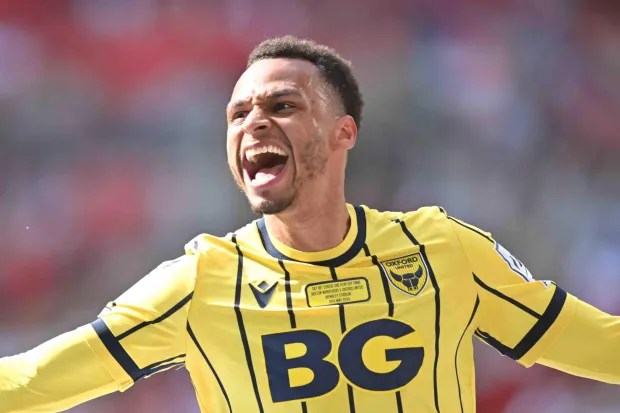
And then there was Murphy. We’ve been here before; Aldridge in 1986, Roofe in 2016, Johnson in 2017 and Henry in 2020 all expected to take centre stage, all who’d become burdened by the expectation. Murphy is, by his own admission, in a mental space that allows his talents to flow. He’s not subsumed by his narrative. After half an hour he picked the ball up, danced into the box and looked up. With a whole body movement, he swept the ball off Ricardo Santos and beyond Nathan Baxter and into the deep Wembley goal. We couldn’t see the deflection, just the perfection, against the white wall of Bolton fans, we could barely see the ball in the net. But we knew the coda, it was Murphy’s trademark.
The vast cavernous bowl was consumed as a tsunami of noise barrelled around the stadium. A disbelieving blamange of bodies collapsed on top of each other. A great leveller of human spirit; no matter whether this was your first game or your 1000th, you’d travelled 5 miles or 5,000, the emotion is the same, the unity is absolute. We had permission to access a new emotional plane. The door to promotion creaked open.
It wasn’t over, eleven minutes later, a vast, cavernous gap opened in the Bolton defence. It was almost surreal in its size. It was Potter versus York, Hebberd versus QPR. Rodrigues looked up and instinctively played the ball into the space beyond their defence, unleashing Murphy again, giving him the mental and physical freedom to be the player he can be. His first touch went wide, but with a brief acceleration he gracefully threaded the ball through the tiniest gap. 2-0. Murphy had played himself into legend.
The spectrum of emotion opened another plain, a beautiful sense of fulfilment, a momentary privilege of release. Absolute freedom to be.
And then we waited for the backlash, the retribution for our audacity. There had to be a reaction, it was just a question of how gut wrenching or humiliating it might be. But as time passed we remained controlled, we retained a clarity of thought, we stayed in the moment. Each second passed until it became a minute, each minute made another fifteen, the clock counted down. Wanting that thing and getting that thing; the immaculate alignment, the Northern Lights of football, it was 1986 and 2010 all over again, a moment of generational perfection.
At the beginning of the first half, they pressed. A succession of corners and throw-ins were greeted with a throaty Boltonian roar. But by the hour mark even the corners weren’t being cheered, we’d broken them. The remaining twenty minutes were as comfortable as you could ever hope to be. Brown and Moore were commanding, Long immaculate. We attacked when we could and looked more likely to score. Unlike the explosive denouement of 2010, we saw the game out, it felt no less satisfying.
The whistle went, an improbable promotion was won, it had seemed so impossible we hadn’t dared to want it. There was no reference point, no dream state to compare this to, every subsequent image was new and had to be processed until we became overloaded and we just consumed as much as we could when we could.
So many games are won by the team who wanted it more, this was won by the team who needed it less. And that’s because we’ve learnt to enjoy the journey, to embrace the casual fans and onlookers, to participate rather than consume. It wasn’t always like that and it didn’t have to be like that, it’s a choice we make.
In the end, this was for those who kept going, who turned up to watch us play Yeading, St Albans and Histon. Who kept the lights on and made sure the club remained relevant. Who endured the ritual humiliation of loss and near misses. Who found humour in failure and absurdity in success. Who gave meaning to the passing of legends, and found heroism in those we least expect it in. It’s for those who gave us a narrative, even when it dwindled to the finest thread and threatened to snap. The freedom fighters of FOUL, the noise makers of the Yellow Army, the podcasters, the bloggers, the commentators, the tweeters, the season ticket holders, the volunteers, the shirt buyers, and most importantly the people who just turned up every damn week because they thought it was important that they did. We’ll all dissolve into the background, become anonymous in the club’s great morass, the names will be forgotten but the experiences you enabled, even fleetingly, will never be forgotten. If you’ve been there all along, that was for you.


 Oxblogger
Leave a reply to Adrian Cancel reply