
Let’s get to it.
It’s 0-0 in a relegation six-pointer, we’ve been the better team, just not good enough to beat them. The board goes up, four minutes of injury time. Some people have left, accepting the point, but our pressure is showing encouraging signs that we could still get something from the game. There are 57 seconds of injury-time to play.
Let’s start with Bradford manager, Gary Bowyer who wound the whole hullabaloo back to a challenge by Curtis Nelson on Eoin Doyle in the build up to their chance. Bowyer described the tackle as ‘wiping out’ Doyle, for which Nelson should have been booked.
Nelson’s challenge is robust, Doyle’s run is checked in the process, but the referee waves play on; Bowyer describes this is as ‘fair enough’. As a result of the challenge, Nelson is out of position and Doyle is able to regain his balance and drive on. He’s the one who squares the ball with Nelson scrambling to recover. He’s clearly got the advantage; wiped out, he isn’t.
The ball is squared to Lewis O’Brien at the back post, he has an open goal; Cameron Brannagan slides in to make a challenge. O’Brien misses. The referee, Andy Davies, who has good sight of it, if a little behind the play, awards a goal kick. On Twitter, a Bradford fan said it was a corner, but the immediate reaction of the Bradford fans is that it was a miss not a block. Bowyer also claims O’Brien said it came off Brannagan, but he doesn’t seem to make a big play for that argument.
Given the velocity and direction of the ball from the shot, it doesn’t look like Brannagan made any contact. That’s not to say it doesn’t take a nick, but there are four Bradford players in the attack, none appear to protest at the decision. Doyle seems to gesture at something, maybe Nelson’s challenge, but he’s not the best sighted Bradford player. O’Brien holds his hand up at something as the play moves on, but spends more time mourning his miss than claiming a corner.
Simon Eastwood retrieves the ball from a quick-thinking ballboy, firmly places it in the six yard box and passes it to Josh Ruffels who is already on his way down the flank. There are three conditions for a legitimate goal kick; the ball must be played from the six yard box; which is fine.
It must leave the penalty box before it is touched. Nathan Cooper claims there’s some question as to whether the ball leaves the box before Josh Ruffels touches it. Gary Bowyer doesn’t make any reference to this, showing that everyone is looking for something different. Curiously, according to the rules, the ball isn’t ‘in-play’ until it leaves the box. So, from the moment Simon Eastwood touches it to the moment it leaves the box, the ball is in an existential crisis, stuck somewhere between being a football and not being a football.
Anyway. The official footage is inconclusive. This video on YouTube shows it from the North Stand; the incident is at about 8 minutes 55 seconds. It shows the ball from Eastwood to Ruffels, someone’s arm gets in the way at the moment he first touches the ball. There’s a still on Twitter which looks like he may have touched it inside the box, but on the video, he seems to be outside and allowing the ball to come across him. He’s predominantly left footed, so it would make sense that he would allow it to come over to his more natural side. It’s not conclusive either way.
There’s nothing in the rules to say why the ball should leave the box. If it’s to protect the defending team, then it’s fairly immaterial. If it’s to protect the attacking team, then it should be retaken because, somehow, they’re disadvantaged. The rules, and that rule particularly, tend to err on the former, not the latter.
There are four Bradford players left behind in the box. Technically, the kick shouldn’t be taken until the box is clear of attacking players; which is the third condition. However, the FA state the reason for this “… is to prevent the attacking player gaining an advantage from being in the penalty area which is not permitted by Law 16.”
With the onus on protecting the defending team’s right to take the kick unimpeded, you have to look at the context. O’Brien is sitting on the floor, two have their back to play and Jack Payne is talking to the ref. None are preventing Eastwood from taking the kick. Bowyer and Karl Robinson didn’t know the rule, nor anyone else, it seems. Nobody protests until the linesman makes a big deal about it.
We are 17 seconds into the incident.
Ruffels sets off, the linesman appears to stop, but the camera pans past him. He doesn’t seem to flag, the fan video doesn’t make any reference to him doing it, the referee doesn’t stop or signal anything, he’s watching Ruffels and would probably be able to see the linesman in his peripheral vision. There doesn’t seem to be a flag, I don’t remember there being one. The incident is over and the play has continued. Any errors made in the previous phase are no longer relevant.
Ruffels launches a glorious cross-field ball to Gavin Whyte. It reminds me of Bobby Moore’s ball to Geoff Hurst in the 1966 World Cup for the fourth goal; massively over-looked in the wider context.
Whyte darts inside, but his shot balloons up, possibly off Jerome Sinclair. When Ruffels makes his pass from inside our half, Jamie Mackie is the closest player to him. When the ball drops from Sinclair’s ricochet, seven seconds later, it’s Mackie arriving to pick it up in the box.
In those seven seconds, Mackie has covered nearly 35 metres at an average speed of 11 miles an hour. His anticipation and desire to get in the box is remarkable. He controls the ball at hip height, and in a single movement, takes a couple of steps to balance himself, then slams the ball home on the volley. It’s a brilliant counter-attacking goal and a sensational finish; in the context of the season, and everything that’s happened in the previous 30 seconds, it’s a goal for the ages.
Pandemonium. The Oxford bench clears, last time we saw that was against Wycombe when we were promoted. There’s some suggestion that Mackie, who had already been booked, might get another card for his celebration. It’s difficult to know what he’s supposed to have done; he’s grandstanding, but it’s everyone else going bananas.
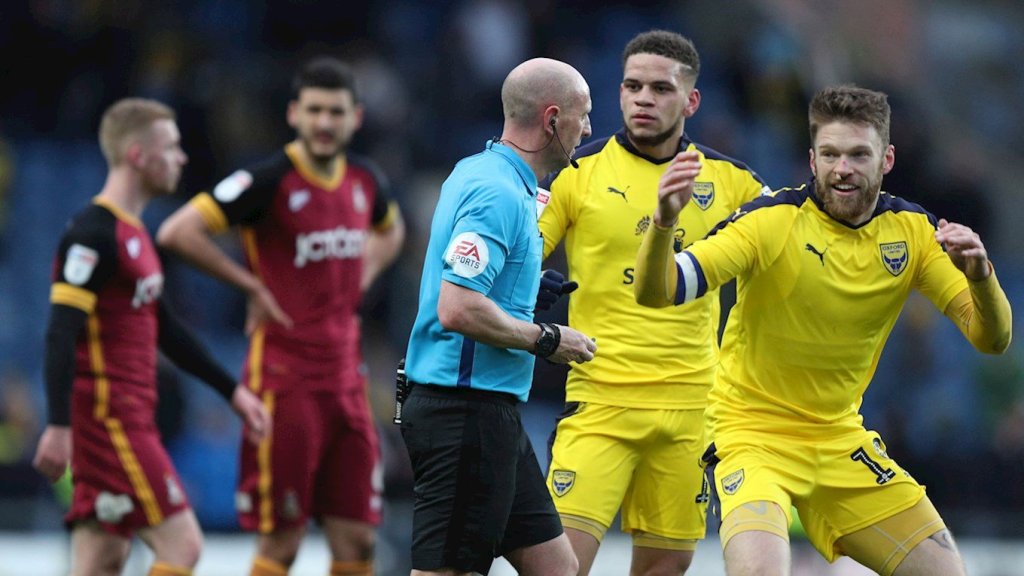
With the dejected Bradford players preparing to kick-off, the referee consults his linesman and appears to disallow the goal. Mackie falls to his knees. Quite why the goal has been chalked off is hard to fathom. A Bradford player picks the ball up and heads for the penalty spot. That’s wishful thinking, there’s no suggestion it’s a penalty, but it creates more consternation. On the advice of the linesman, the referee appears to be pulling the play back to re-take the goal-kick, presumably because of the players in the box.
Players and officials start pushing and shoving on the touchline; Curtis Nelson calls for non-existent VAR, Karl Robinson suggests afterwards he watches too much Premier League football (which doesn’t have VAR). He ignores that he also gestured to the video team at the back of the stand to see if they can help. We can see you Karl. Hmm.
Afterwards Jamie Mackie claims he asked the referee to take some time to reconsider. If he did, it’s good advice because if he disallows the goal, he’s got a major crisis on his hands. The ref consults his other linesman. Presumably that’s not because he’s seen something different, perhaps to get a second opinion. If he’s done that because of Jamie Mackie, then Mackie is a god twice over.
The goal is given, it’s a horrible way to lose a game and a great way to win one, but it’s the right decision. Law 5 states: “Decisions will be made to the best of the referee`s ability according to the Laws of the Game and the spirit of the game”. In the spirit of the game, the goal-kick issue is trivial and the goal should stand.
There are only 17 laws in football; the rest is process and interpretation. There were Bradford players in the box when the free-kick is taken, which is the only bone of contention, but the law says that a re-take ‘may’ be taken (not ‘must’) if the process isn’t followed. It’s not considered a foul, it’s a process issue. Nobody should be punished.
The interpretations of that law puts the onus on protecting the defending team (us). There was no reason for the referee to get the kick re-taken. If the Bradford players were protesting at anything, it was that the referee hadn’t punished them for getting out of the box for the kick. It’s a funny world.
The referee’s error in handling the situation was probably two-fold. The game had long moved on by the time the issue was highlighted. He should have decided that the incident was in the past – the game had restarted, in which case the incident is no longer up for discussion (Law 5) – and trivial in context.
The second thing is that he should have taken both his linesmen to the side and decided in a single decision. Moving from one side of the pitch to the other meant players followed him around creating more mayhem. If anything, the linesman’s pedantry was at fault as it put doubt in the referee’s mind. In a world where VAR is considered the answer to everything, maybe the ref needs to be praised for taking the time to figure it out, or for listening to Jamie Mackie.



 Oxblogger
Leave a reply to The wrap: Oxford United 0 AFC Wimbledon 0 – Oxblogger Cancel reply