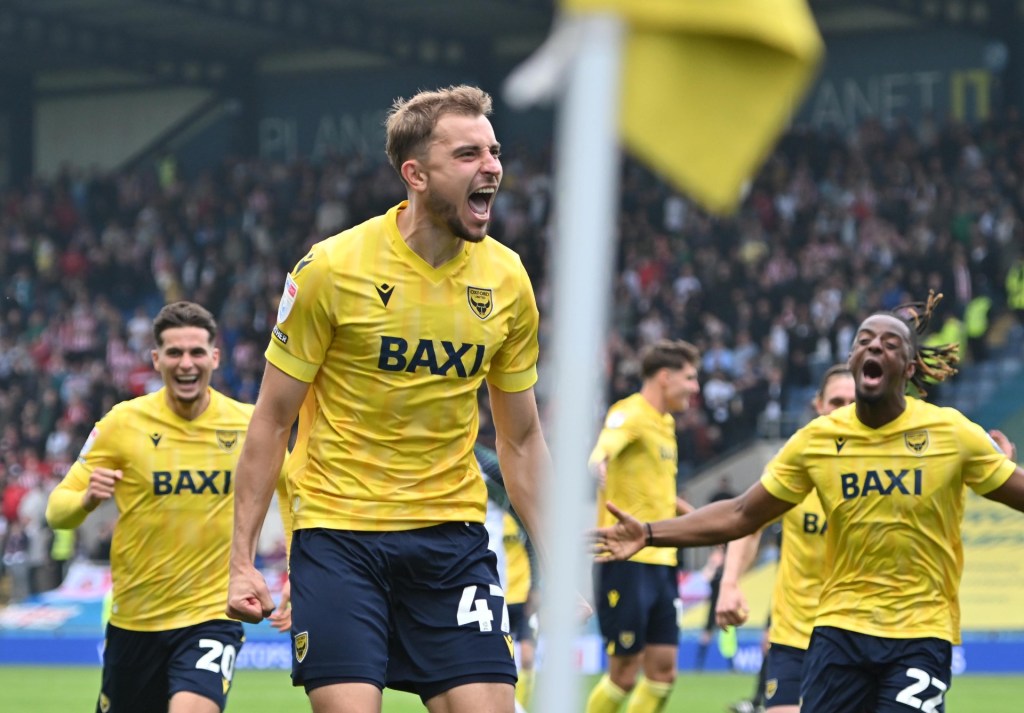
They say that attack is the best form of defence, well, at Oxford United last season, defence was the best form of attack. With Greg Leigh sharing the golden boot with Mark Harris last season, have we seen the last of the good old fashioned non-scoring defender? Graham Dunn investigates.
As Oxford prepare for another crack at Championship survival, all eyes will again be on the goal-scoring engine of the team. The defence.
Defenders scored 19 of United’s 52 league and cup goals last season – a share which would probably have tipped to over half if Michal Helik had arrived before January.
Impressively/embarrassingly (delete as appropriate), Greg Leigh was joint top scorer with six goals, while Helik and Ciaran Brown were not far behind with five and four respectively. Sam Long, Elliot Moore, Ben Nelson and Hidde ter Avest also found the back of the net.
While the current reliance on defenders to score is particularly pronounced as pragmatism leads over style, even the most free-flowing football days of Karl Robinson were typified by timely goal contributions from full backs Long and Josh Ruffels.
But it wasn’t always that way. In fact, not that long ago Oxford had one of the best, both at defending – and not scoring.
When Jake Wright chipped in with two goals in 22 starts in his breakthrough season with Halifax Town, he must have harboured hopes of settling into a bulk standard three or four goals a season career. Sure, he probably realised there would be the odd blank season or two along the way, but he surely couldn’t have guessed the extent to which the 2006-07 season would prove a goal-scoring high.
But over the next 14 seasons – half of them starring for Oxford, including in two promotion winning sides – and 384 starts later, Jake Wright failed to score again.
It’s pretty incredible really, given how good he was. Yes, Wright’s pace meant that, unusually for a centre-back, he was often left to hold the fort at corners. But I’m sure he went up for some of them. Across 248 starts for Oxford, you would think he must have been in the penalty area enough for one to go in off him at some point. Even the David Hunt-Tom Newey experimental season (more a jazz band name than a pair of full-backs) got one goal.
And let me be clear. Wright is one of my favourite ever Oxford players. I think he was a little under-appreciated at times by Oxford fans. He had pace, was consistent, was comfortable on the ball and a leader. He just was not a goal-scorer.
Which is a shame, because as with all favourite players, you want them to score. There’s nothing like missing a game, finding out Oxford have scored three and that they were scored by three of your favourite players (the evil twin sister of which is finding out two were penalties and another an OG). But as the seasons went on, and despite Wright becoming ever more integral to the team, it became apparent he was not going to score.
Then one hot August night in 2014 at the Hawthorns, it looked like the script was finally written. After clinging on through extra time for a gutsy 1-1 draw, Oxford embarked on a penalty shoot-out with WBA that never looked like ending. Eight penalties in and locked at 6-6, up stepped Oxford’s ninth penalty taker – Jake Wright. Don’t let that he was our ninth penalty taker fool you. He was only that high because Junior Brown had been sent off in extra time and we had a rookie Max Crocombe in goal that day. Surely fate had brought this moment to be a goal-scoring hero. But this was no film script. Spot-kick saved, non-scoring record intact.
After that moment it was almost as if Wright leant into the cause of not scoring. He was increasingly rarely spotted in the box, and by the time he left United, he was typecast as not scoring. Another 100 plus games for Sheffield United, Bolton and others ended without him scoring.
Of course, he is far from the only player not to find the back of the net through their Oxford career, many of whom were more specifically paid to do just that.
Neither is he the only club stalwart to struggle for goals. Les Robinson managed just six goals across 10 years and 459 appearances for Oxford. In fairness three of those were belters, but that’s a pretty low return given his occasional appearances in midfield – two of his goals came back-to-back when he was playing as a ten, or at the very least was wearing the number 10 shirt (special thanks to Jim Hendo who helpfully posted all his goals together in one place here).
But that actually marked an improvement on his predecessor Gary Smart. Coming after the attacking exploits of right backs Dave Langan and David Bardsley, Smart arrived in the summer of 1998 after United had just leaked 80 goals in 40 top-flight matches and was clearly signed to defend. That was a cause he took literally, not only failing to score in 170 league matches (and just over 200 games overall with United), but at least from my memory, not even looking like scoring during that period.
More recently, Joe Skarz managed a creditable 89 games in Michael Appleton’s fun-loving title winners without scoring.
So, yes, I’m enjoying these heady Gary Rowett days of goal-scoring defenders – and not just because that’s almost all we have right now, but because of the freakish interest in seeing just how big a share of goals defenders could end up with. But part of me yearns for the simpler days when defenders defended. And nothing else.
The Oxblogger Newsletter
This article was first published in the Oxblogger Newsletter, a bi-monthly Oxford United fanzine by the fans for the fans. See the whole issue here and subscribe to get each issue straight to your in-box each.
 Oxblogger