I have seven old school friends, who I’m still in touch with. With partners and children, we number nearly 30 people. Nowadays, it’s almost impossible to get us all in the same room at the same time, but we’ll pitch a date to meet months in advance to navigate everyone’s busy and evolving diaries.
A few months ago, some of us arranged to go for a walk on Bank Holiday Monday, I wasn’t planning to go to Portsmouth and figured a morning hike would set me up for an afternoon in front of the TV. Equally, I’m not entirely insane, these are special people.
Then, as the game grew more pivotal, the kick-off was moved to 12.30. It seemed churlish to reorganise, so I decided I’d try to ‘Likely Lads’ it.
For the uninitiated, Whatever Happened to the Likely Lads is an old sitcom whose seminal episode sees the titular stars, Terry and Bob, try to avoid the result of an England v Bulgaria international so they can watch the highlights on TV in the evening.
I had low expectations in our hyper connected world. I switched off all notifications, told my daughter – watching at home – not to message me and put on a podcast in the car to avoid the radio spewing out the result. We reached our meeting place, stepped into the idyllic sun-drenched world and looked up at the hills in front. I was in the hands of fate.
Reader, I hate to break it to you; but we’re just not part of the cultural zeitgeist. Years ago, due to a childcare mix up, I had to avoid an England World Cup game so I could watch it later. We went to a remote wooded playground for a couple of hours, but the coffee kiosk played the commentary on the radio and as I drove home England fans were spilling out of the pubs; there were clues everywhere as to the result. In the end, the game was effectively confirmation of a result I already knew.
I once read an article by Josh Widdicombe who said that he didn’t do comedy about football because it’s not universal enough for a wide audience. As popular as it might be, it’s still a speck of sand in comparison to our collective experiences of love and hate, friends and family and the absurdity of ever day life. On Monday, there were hundreds of people out in the spring sun; hikers, cyclists, runners, shoppers, and pub lunchers, and literally none of them wasted a nanosecond on our relegation plight.
But there was a consequence; those who did know my quest were suddenly unnaturally interested in its outcome. My friends and family have little interest in Oxford United, but they were super excited to get in on the secret, checking their phones constantly, trying to avoid a knowing look as to what was happening. Every twitch was there to be interpreted. It created a neutron star of expectation with a density and gravitational pull which was almost irresistible.
As we drove home, the reality hit me, was I nervous because of the game or the possibility of someone letting slip the result? My goal had been to avoid the result, but that objective had obscured the real purpose; for us to win the game. I was about to climb into the snake pit; my family home. Everyone knew the score apart from me and I needed to know the score more than anyone else. I told my daughter I wasn’t going to look at her; so she couldn’t inadvertently give something away. She knew the outcome, but wanted to watch with me. But why? Because of our glorious win? Our ignominious defeat? She lined the game up and hit play.
But it wasn’t over, with everything blanked out, it was just me and what I was watching. At a game, you divest the self to a collective whole, at home I’ll have my phone as an outlet, checking the collective response to what’s going on. I couldn’t even talk to my daughter who was watching the Sheffield Wednesday v Leicester game on her iPad. She alluded to that game, but should I know about that? Or should my knowledge of the outcome be delayed? Was it just our game that time shifted, or all games? I hadn’t thought it through. It didn’t feel right that I should know for risk of polluting the outcome of the game at Fratton Park, eventually we found a sidebar conversation about the Women’s FA Cup to make the silence less awkward.
The pulsating intensity grew; I realised there were three pockets of time co-existing – the result of the game in the past, which everyone knew apart from me. Me and the recording of the game itself in the present, and the debates that were raging now, but for me would be in the future.
Fratton Park was alive with a dirty chaotic energy; like a traction engine honking out plumes of polluting gas. We had to close it down but succumbed too early and too easily; a clever turn and shot by Keshi Anderson opened the scoring. The room was silent, we couldn’t discuss our defensive shortcomings because the conclusions had already been made, I could only mumble to myself about the purgatory of watching our inevitable failure.
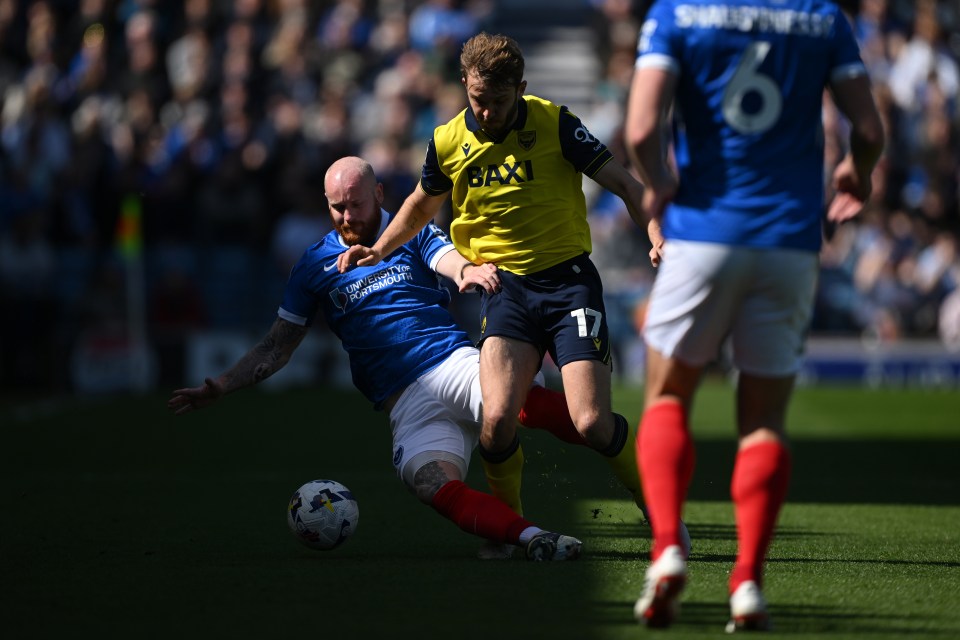
Just as it looked like we’d fold, Connor Ogilvie scythed down Stan Mills. Off camera, the referee pulled out a red card, the crowd fell silent, the commentators missed it all. There were no social clues, no shared vigilance about what was going on. For a moment there was dead space. The replay showed Ogilvie’s scissor kick challenge; it wasn’t dangerous, but it was out of control, it was harsh, but the game pivoted.
The commentary team scolded Oxford’s lack of response; but swarming forward with everyone still fresh would have been reckless; we would have to win our advantage piece by piece. It made the game slow to a crawl; I wanted it to be over. A feeling made worse by the fact could literally achieve that at the press of a button.
It took until half-time for Matt Bloomfield to form a plan; a switch to a back three allowed more attacking threat. The outcome was instant; Mills, a constant menace, shoots, and the keeper parries into Spencer’s path for the equaliser.
Parity; in truth, both sides could have swapped shirts and they’d it would have looked like the same game. We’re basically the same club; such was the intensity of our stares, it’s likely we’ll both go down because of what’s happening elsewhere.
On the hour Spencer clips Devlin as he races down the wing. It’s a yellow, which means he’ll be sent off. Inexplicably the referee, who painted himself into a corner from the off, doesn’t reach for a card. The Pompey fans are rightly apoplectic, but the Fratton Park’s raging torrent has been re-channelled, the injustice threatens to flood them.
With ten minutes to go, Swiss army defender Michal Helik wrestles himself the ball and delivers a cross to the back post to Lankshear who flies in for 2-1. The world swings; green shoots of survival appear, Spring has arrived.
But, we panic and defend too deeply, with three minutes to go Andre Dozzell sweeps in a cut back for 2-2. At the moment he strikes the ball, we have every player behind the ball. It’s a terrible goal to concede, but you can’t deny the game is bordering on a classic and its a privilege to see it evolve into one.
Despite the earthquake, nobody moves. Not for the first time, the pivotal result is elsewhere; Leicester’s dropped points at Sheffield Wednesday turn our two points lost into a point won. I reconnect with the outside world and there’s doom and gloom; the immediate reaction is our failure. But with the benefit of the Leicester result, it turns out the day could have seen us four points adrift instead of one. With the games to come, for the first time in a while, I think we’ve got a chance. For many reasons, we’re the least likely to survive and maybe the least deserving; but while we’re still in touch with safety, that’s just the kind of narrative twist that happens in a season.
 Oxblogger
Leave a comment