On Saturday morning, before the Southampton game, I saw a tweet from someone addressing any Oxford fans who were going to their first away game about ‘sit where we want’ lore. They said you needed to be in your designated seat by 2.15pm or accept that you’ve lost it. Under no circumstance, they said, can you expect to sit in your allocated seat after 2.30pm.
‘Sit where you want’ has very strong back-of-the-bus energy; it’s an indulgence in polite anti-establishment anarchy. Like your gran letting you have a biscuit after you’ve brushed your teeth.
Applying it as a rule with designated timeframes is as authoritarian as the rule that you should sit in your seat allocated seat. It’s not an act of rebellion, it’s an acceptance of a rules-based system.
What got me pondering this tweet wasn’t just the fact that someone, somewhere decided they had a public duty and personal authority to broadcast their brain fart to almost nobody. It was that it was addressed to those attending their first away game. In other words, they’d divided the world neatly into ‘us’ and ‘them’. If you don’t abide by our rules, then you can’t be part of us.
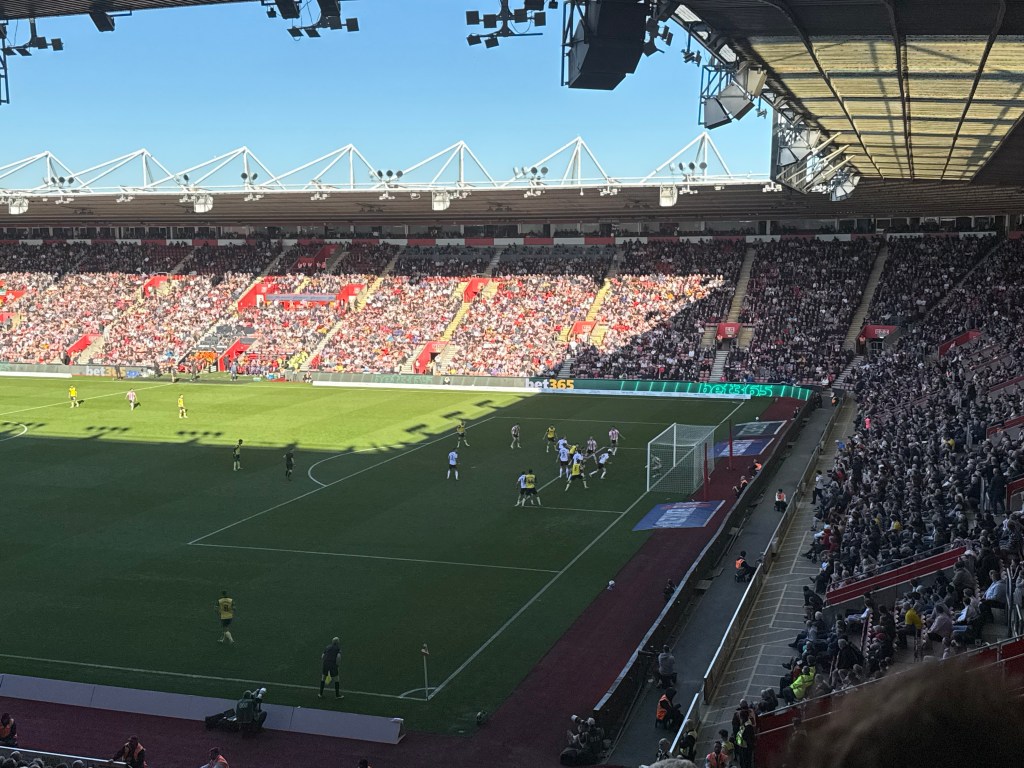
The atmosphere at St Mary’s had a different energy, the first proper sun of Spring gave the game the feeling of the opening day of the season. Coats were discarded to reveal a bloom of colour, the red and white, the yellow and blue, the flora and fauna of our Ashmolean collab. Somehow the air felt a little fresher, maybe it was the sea breeze.
The ambience felt free of tension; after some good form, we’re now in a position where this result won’t define our season. Instead, it was an easy trip to a new stadium without any real expectation. Equally, they’re more comfortable in their skin than they were after going thirteen games unbeaten and finding form at the right time. With the international break on the brow and then the run-in to come, we were both exactly where we expected to be.
The game started brightly enough; Miles Peart-Harris danced down the wing to secure a corner which caused enough panic to give Cairon Brown a half-chance in the opening minute. Nobody really saw it as the clarion call for a great upset, but it was an encouraging opening.
Within seconds, Taylor Harwood-Bellis, a man with the name of a Victorian adventurer, discovered a plain of fertile land behind Jack Currie. Harwood-Bellis’ pass went into a space so vast and uncharted, it probably disturbed undiscovered tribespeople and featured previously unknown plants and serums that could cure diseases. Currie raced back in hope more than expectation, but we were now in the hands of Southampton’s competence; Tom Fellows set himself and squared it to Cyle Larin to side foot the opening goal.
Seven minutes later, an inventive short corner routine worked the ball out to Shea Charles in so much space it was, well, like reading the previous paragraph. In a season dominated by set pieces, we drifted out waiting for the cross back into the box. The hesitant muscle memory gave Charles the time to cudgel the ball into the top right-hand corner, arching beyond the frame of the goal and back in. Jamie Cumming could only offer the most cursory attempt to save it. You simply had to admire it, not just for its quality, but for the audacity of trying the lost art of shooting from outside the box.
Southampton fans convulsed as the goal was punished by their ‘social media star’ Paul Dawson performing his gut churning viral celebration dance to Zombie Nation’s Kernkraft behind the goal where the ball nestled. As the Electroclash drone subsided, the Oxford players gathered in a huddle; the objective had shifted. It wasn’t just the possession stats we wanted to keep down to single figures, it was the score too.
But the onslaught didn’t come, Southampton having played in midweek, seemed largely sated by the quick kill. Far from having blood dripping from their fangs and wanting more, they lay back to bask in the spring sunshine.
The struggle was all ours; Will Lankshear toiled in isolation; Peart-Harris and Stan Mills offered some outlets, but without Jamie Donley to link the midfield to the attack, Cameron Brannagan became less libero, more librarian. The gaps were too great to construct any real threat, but then, we hadn’t planned to be 2-0 down after 12 minutes and looking for goals. It was brave and ineffective in equal measure.
Time slipped by at pace as a sense of acceptance settled over the game. Just after the hour, we started pressing them back as, liberated from expectation, the Oxford fans found their voice.
A couple of set-pieces showed promise, before Will Lankshear charged down a complacent pass from Jack Stephens. Lankshear was suddenly free with half the pitch to run into, it was Mark Harris against Leicester. As he reached the box, he transitioned from his sprint, trying to shape to shoot. As he did, he stumbled. It was almost imperceptible, the kind of fatalistic other-worldly intervention that Uri Geller used to claim he channelled. Off balance, he still managed to get his shot away, from the away end it looked like he’d done enough but it slid past the post and wide. Lankshear held his head in disbelief, but it was hard to know what more he could have done.
The chance rallied us briefly, but deep down we knew the moment had passed. The two sides seemed to merge into a curious co-existence. If they can secure promotion, then their reward is probably another punishing season in the Premier League. If we can survive the Championship, we’re going to have to accept more of these games. We’re two sides stuck in a liminal space between divisions.
The referee rewarded everyone’s patience with mercifully little injury time, the game gone, Oxford fans switched to the bigger picture and the fights to come. As a singular noise cascaded from the stands, the players acknowledged the support. We may have little, but at least we have this. There’ was no us and them, no toxic blame culture, no finger pointing. We live and learn together, it’s the only way to exist.

 Oxblogger
Leave a comment