I was reading recently about the influence of American owners on football in England. Americans see sports clubs differently to us; while we see clubs inextricably linked with their location and history, the franchise system means they’ll happily move location to where the money is.
The draft system, where the worst teams get to choose the best new players is, perhaps, the most socialist thing Americans do whereas in England we’re happy to allow financial inequality to squash the sporting spectacle.
The attitude towards fans is different too; American sports don’t really see season ticket holders as their most important customers and they do as much as they can to make tickets available to casual fans and tourist. The problem with loyalty is that it becomes routine. Those routines are so efficient, the potential for growth is limited. Going to a game involves a drink or two with friends, trips to the club shop are infrequent, and although you pay more over a season, you pay less per game.
The tourist version of you makes a day of it, treating yourself to food and drink, stocking up on merchandise, gasping, but ultimately paying inflated prices. On Friday night I was at the O2 Arena, and bought a bottle of water for £4.50, complained (inwardly) and wrote it off as a one-off. The merchandise stall was selling t-shirts for £60; the queues were prodigious. Tourists are much more lucrative than regulars because they accept the one-off premiums they have to pay. It will surely be part of the calculation with the new stadium; if the club can get on the Oxford tourist trail, the new stadium’s business case will be assured.
On Friday night, a friend decided to go firm on his long-term commitment to go to an Oxford game. The family was at a loose end and given the state of the two sides, he figured he’d just turn up. There weren’t many tickets, but they were available. He didn’t think he’d need to to buy them in advance.
Via WhatsApp I explained what he was letting himself in for ‘This is it’ I said, ‘shit or bust’. Even with my hyperbole, he seemed largely oblivious, with us six points adrift he’d assumed the days of must-win games were long past.
In the great scheme of things, our plight and fight is a localised issue. While the regulars may be consumed in the drama, outsiders won’t give it much thought. Even followers of clubs sitting in mid-table will waste little time with it. The novelty of this season’s relegation fight is not us; it’s Leicester and West Brom. Teams, by rights, that shouldn’t be there.
But they are, and they’re still recovering from the shock. West Brom are still processing the anger phase of their failure having just fired their second manager. At least Leicester, with Gary Rowett now in charge, appear to be addressing the real issue.
So, as has been the case many times this season, we had an opportunity to stir the pot of their toxicity. Let’s release the noxious gases and let them fester in the noses of the West Brom fans and players. Maximise the damage, even if most Oxford fans are resigned to our plight.
From kick-off it was clear that this wasn’t the plan. We set up in such a low block, for 20 minutes nobody could buy a steak and kidney pie from under the East Stand. After four minutes we conceded our fourth corner. It wasn’t so much an onslaught as a concession.
We defended like we were protecting an away point in second half injury time, only there was 85 minutes still to go. Michal Helik, who at times this season has inverted his nice-guy off the field image into his on-field persona, defended with renewed commitment. Maybe he was angry about being the sanction for Christ Makosso’s poor timekeeping, or simply he was seizing an opportunity. Either way, it’s good to see the old Helik back.
At least defending deep is something we know well. Despite conceding possession and territory, it allowed us to ease into the game as their initial enthusiasm withered. The problem was that we were, territorially and psychologically, far far away from scoring a goal ourselves.
Before each game, the club play a rousing montage of our great moments, Tony Jones against Blackburn, the Milk Cup Final, Joey Beauchamp’s goal against Blackpool, Alfie Potter at Wembley, Josh Murphy in 2024. Tacked on the end are more contemporary highs, the last of which is Stan Mills’ last-minute winner against Southampton. Watching it feels like seeing archive footage, you half expect Ron Atkinson to join the celebrations.
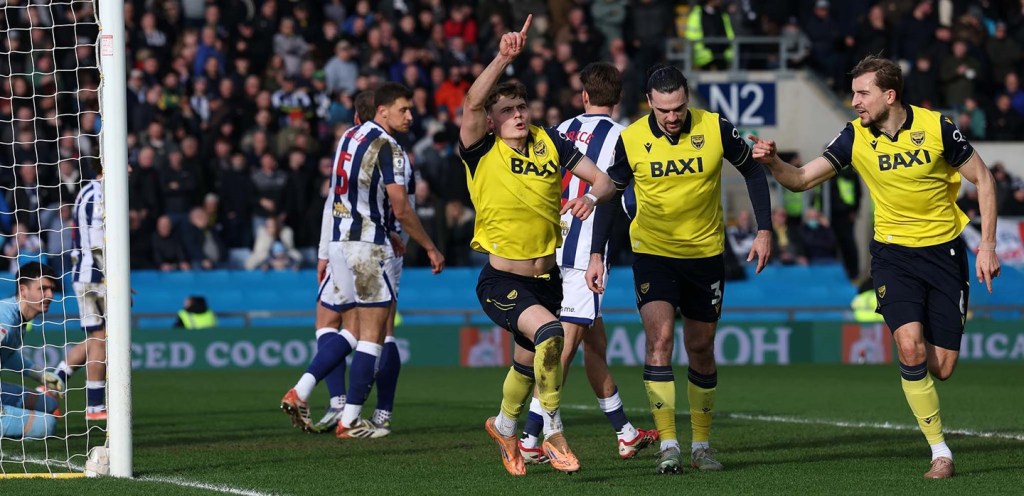
Mills’ goal was 540 Kassam minutes ago, which scientists believe is the equivalent of 20 earth years. Fourteen minutes in, we found ourselves wrestling the novelty of being in an advanced position. Jamie Donley’s corner swung in; Mills leapt back to direct his header into the net, bookending the drought. A goal, and actual goal.
The mood lightened, a tension release, football didn’t feel like it was being done to us anymore. Twelve minutes later Cameron Brannagan, wrestling with what his mid-career persona should be, reverted to his comfort zone, delivering a free-kick into the path of Will Lankshear for number two. We had clear, clean water.
The second goal triggered movement in the North Stand, a small but noticeable exodus. If you want to understand the psychology of a football club, watch the opposition’s fans. Some West Brom fans had seen enough, their retreat to the pub or their car draining any confidence they might have had.
Just after the half-hour, Ollie Bostock’s speculative drive cannoned off Brannagan to wrong-foot Jamie Cumming and we were back on a knife-edge. But while the away fans were muted in their celebrations, there was a resolution amongst the home support. The discomfort felt familiar, but still something we could deal with.
The game descended into two private hells colliding and intertwining: us, daring to dream and hating ourselves for it. Them, lost and trying to find a signal. Chances were scant, this wasn’t about football as we know it.
A neutral would look on bewildered by the spectacle, two teams hacking and thrusting, a macabre dance. At one point Sam Long won a throw in and celebrated with Mark Harris like a couple being told their IVF treatment was successful. It was unconfined and primal, but it was still just a throw in.
West Brom’s threat and onslaught never materialised, we saw out injury time and celebrated wildly. They are now deep in their own private hell while, for a few moments at least, we can escape ours. We’re still not in a fight for survival, but nor are we out of it. We have a chance and no more, but a chance is all we asked for.
 Oxblogger
Leave a comment