When you’re having the season we’re having, it’s easy to get paranoid. For example, it’s been months since we’ve had a 12.30 kick-off on a Saturday. For many, that’s a good thing, personally I like the tradition and routine of a 3pm kick-off, but I’d also like to feel that we’re important enough for Sky to occasionally allocate one of their fancy kick-off times to us.
There are numerous reasons why games are chosen for the lunchtime slot, a central one must be The Narrative. If a fixture has a bearing on promotion or relegation, is a local derby or enjoys a notable history, then you’re more likely to get neutrals to watch the game.
For several months now, certainly from an external perspective, we haven’t had a narrative worthy of much discussion. We’ve had our localised dramas; a new manager and signings, but nothing that would tweak the interest of those beyond our borders. To the outside world, our direction seems to be entirely linear and predictable. To the outside world, we’re getting relegated.
Recently, though, we’ve had two fixture changes; both Preston and Charlton have been moved for TV while Blackburn has quietly become Sky’s feature game on the 11th March.
This is where the paranoia kicks in. At any other point in the season, these fixtures wouldn’t muster much interest. Have Sky decided that we’re doomed and it’s just a question of showing our suffering and inevitable demise? Do they just want to be there to beam our crying faces to the nation?
The FA Cup is similar, despite our poor form, we were still selected for live coverage. But why? For one, there are so many TV slots available, even at the fourth round stage, the decision about which to feature must draw on an entirely tenuous algorithm.
In this case, there was no Manchester United, which typically takes up one slot and only two all-Premier League games. With the exception of Arsenal’s trip to Wigan, Sunday’s games were characterised by mid-to-low ranking Premier League sides visiting EFL teams. Their hope, one assumes, is that somebody would muster an upset.
And so, the algorithm coughed up our game against Sunderland as a fixture of note.
But the desire for a giant killing overlooked the fact it would be the twelfth meeting of the sides in seven years, ten of those in the league. Sunderland fans might hate to admit it, but we’ve been peers for the best part of a decade.
Someone at work thought I’d be pleased to have a Premier League side visit the Kassam and seemed perplexed that I was underwhelmed. Even Sunderland fans seemed surprised that we hadn’t gone weak at the knees at the prospect of hosting a ‘big club’, ignoring that the very same ‘big club’ had lost here just ten months ago. So, no, this didn’t have a ‘big FA Cup tie’ or ‘potential giant killing’ feel to it at all.
It was, however, the kind of game we needed given the ferocious backlash following the Norwich game on Tuesday. While the display itself was an inept embarrassment, the wider catastrophe it was supposed to foretell was wildly overstated. Matt Bloomfield had overseen three clean sheets, an excellent away win over Leicester and a creditable draw over the league leaders away. It reminds me of Liam Manning’s start in 2023 when he secured our porous backline as a priority. The problem was, against Norwich, as soon as Bloomfield took the handbrake off, we rolled down the hill.
We needed a good test that didn’t really mean anything, just to stem the bleeding and remind us that we weren’t complete failures. Rather than offering a grand old classic cup tie, Sunderland simply offered us an opportunity to reset.
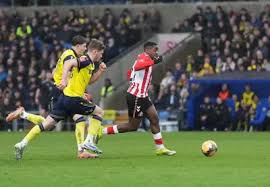
And that’s how it turned out, they looked like a strong and physical unit, but we looked relatively comfortable, absorbing the little they threw at us. Only Romaine Mundle offered anything beyond what we’ve experienced this season.
Given we had two solid units, the game that was always likely to be decided by a momentary lapse. After half-an-hour, it came; Cirkin danced around aimlessly on the edge of the box, Christ Makosso made a half-hearted attempt to clip the ball away from him and the full-back collapsed on the floor.
It was a good example of the disproportionate advantage a penalty kick can give a team. There was no prospect of Cirkin creating a chance or shooting, even if it was a foul it wasn’t dangerous and certainly didn’t warrant giving them a free shot on goal.
Given the conditions, it was always going to be a gritty encounter. Unfortunately the referee wouldn’t allow the physical side of the game to develop even though it wasn’t a particularly dirty affair. This was a particular handicap for Will Lankshear whose game is all-action. Once he was blunted and isolated, our chances of getting back into the game were limited.
Matt Ingram made a number of solid saves and came away with more of his credibility restored and some even calling for him to replace Jamie Cumming, but otherwise the game petered out and Sunderland slipped into the next round.
Neither side’s season was ever going to be decided by the result, this time next year we’ll have forgotten it happened at all. Ultimately, this wasn’t about triggering a big turnaround or writing a giant killing into the history books, it was an opportunity to cleanse the palate, shake some of the paranoia and prepare for the battle ahead. On that front, it achieved its objective.

 Oxblogger
Leave a comment