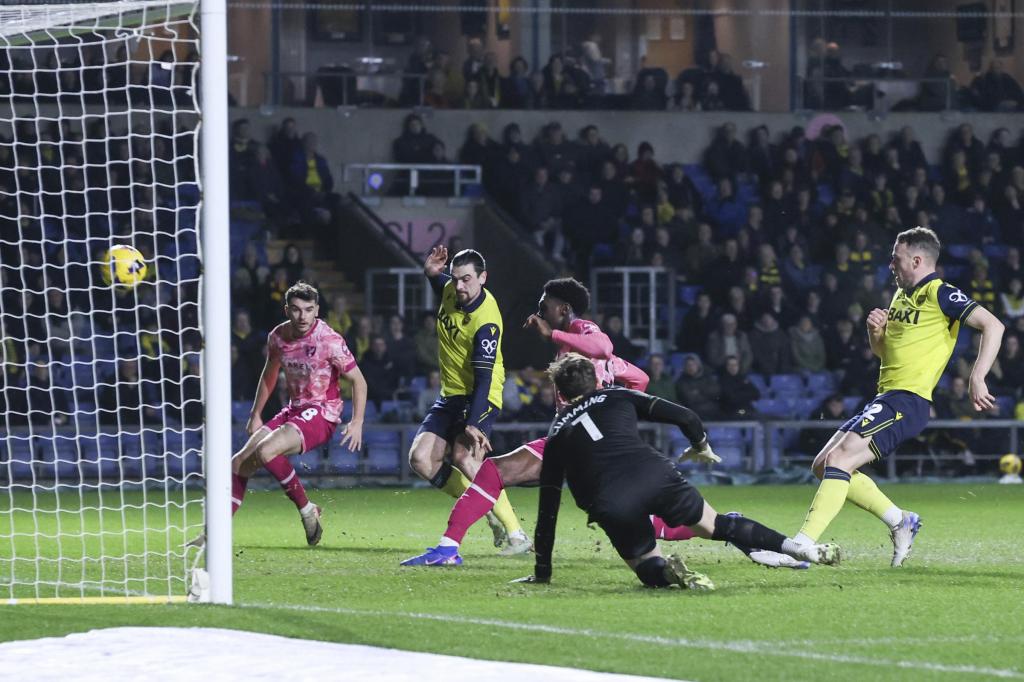
The ball arcs into the illuminated skies. Its launch is long, unfettered and direct. This is the established science now; Cruyff is dead, tika-taka is too woke for our combative times. It’s time for The Powers to take back what they believe is theirs; unfussy, without nuance; press, block, power, pace, aggression, destroy the withering and weak. A rehashing of the dark ages, recast as new.
The fixated gaze on this bag full of wind sailing through the air must mean something. In itself, the ball is meaningless, but its very existence is a point of cultural reference. It’s much coveted, fought over, desired, tossed around and frequently beyond our control. We obsess over it; where it’s from, where it’s heading, who possesses it, how they possess it, what it means, how to protect and exploit it. Is it a proxy for the self? For time? For our very mortality?
Within its arc is the history of man; the leaden boots and lacquered hair of the Atkinson brothers and the roar of the Blackburn Game. The craven decay and then the arrival of a millionaire laden with wooden dollars and a ghostly slight of hand.
A bald Yorkshireman who lavishes us with glory, expands our horizons and inflates our ego. Ambition is unconstrained, unlike the cocoon of a city protecting its feted identity. The Manor is a home, then a refuge, then a burden.
The bubble bursts, the millionaire is dead; accident? Suicide? Assasination? The fallout is grotesque; his family propelled into a moral abyss, the futures of millions are put at jeopardy and in this tidal wave, a trivial football club ruptures and haemorrhages.
Back in the present, the ball reaches its apex and then begins to descend; its trajectory is flat, fast and deliberate.
We limp into the 1990s before a brief shard of hope shines through; an ambitious owner, an inveterate dreamer, a new stadium, a new start, a different future. It collapses under the weight of history and the naivety of ambition. We’re caught by a hotelier with his own coda; his risk, his reward, his club. He re-homes the club and sells its assets to himself, possessions which were built by the club; the fans and the players. It makes him millions and we’re expected to be thankful.
Our new home with its three utilitarian barns is completely incomplete. Our opponents goad us like we haven’t noticed. A fourth stand, like the Loch Ness Monster or George’s Dragon, exists only in legend. The existence of the stadium gives us a place and an existence, but the lack of care erodes the psyche, which erodes confidence, which erodes everything.
We feel unloved because we are unloved, we descend and descend further. Nobody cares, until those who can still smell the embers of the past return. Merry, Smith and Lenagan combine to drive out the demons, both literal and figurative. Wilder evades gravity and turns the juggernaut around, major surgery is both necessary, scarring and successful. Then Eales and Appleton breathe fresh air into the vacuum; not ignoring the past, but building the future.
And as we watch it fly, the gaze shifts from where the ball is to where it might land. On the face of it, it appears unthreatening, the models in our mind give ourselves a false security.
History turns again, a mysterious consortium; fronted by a cartoonish owner who brings in the equally cartoonish manager; Karl Robinson. Like a series of one night stands; it’s fun, wild and frustratingly unfulfilled.
And then a confluence; new investors, serious players with vision and means, a promotion which is almost accidental in its nature. Off the pitch, we’re righting historic wrongs, on the pitch we’re leaping ahead of ourselves into the future.
The ball drops towards Sam Long whose legacy and connection is measured in decades, but he’s executing a plan devised in days and practised in hours. He steps up to press the opposition into a rearguard. Its intention is positive, but the ball’s flight has no interest in intentions; the two are jarringly out of sync.
The future comes fast, maybe too fast; a manager who gets a player, a player who needs a stage. Wembley, a day in the sun, the shock is blinded by the glory. We’re not ready; ill-equipped in every sense, but we don’t care and choose, instead, to embrace our good fortune.
Stuck between a plan to attack and a need to defend, the ball evades Long, the shock is visceral. Toure, Norwich’s whippet fast striker, tracks its trajectory; attuned to what’s happening not to what we want to happen. Panic engulfs us, Cumming swipes and misses, the weight of history cracks us open, the ball hits the back of the next. The clock registers just 53 seconds.
It took just under a minute on Tuesday for Oxford fans to be confronted by their own reality. Perhaps it was the most stark realisation about how much of our past needs to be upturned to establish ourselves as the club we’d like to be.
Matt Bloomfield faced the wrath after the game, admitting he’d made a mistake; in an attempt to break our goal duck, he sacrificed the defensive stability that has seen more clean sheets in his seven games than the whole of the rest of the season. An error? Yes. Foolish? Yes. Naive in its implementation? Almost certainly. A systemic failure all of his doing? Of course not. He explained and didn’t defend it, he owned it. He agreed. What else did you want him to do?
You can beast the players for a lack of effort, the manager for foolish decisions or walk out in a performative rage, but it doesn’t change the quest. Every manager, player, fan and owner is fighting our history and, as such, progress will always be gradual and non-linear. It’s one that you either accept and embrace, or walk away.

 Oxblogger
Leave a comment