I maintain, had it been forged in the 1960s, a rivalry between Oxford and Wycombe would have taken a very different complexion. There’s always been a reluctance, particularly amongst Oxford fans, to recognise it as such. Perhaps it’s a form of recency bias; our mismatched histories are too vivid in our collective consciousness. Perhaps it’s a question of connectivity; it’s quicker to get from Oxford to Wycombe than it is from Oxford to Swindon but only because of the M40, which didn’t connect Oxford to Wycombe until the 1970s.
If the rivalry was a rivalry, then the period in which Karl Robinson and Gareth Ainsworth were in charge might represent something of a golden era. There was Josh Ruffels’ last-minute winner in 2019, the 1-0 win a few months later which saw Adebayo Akinfenwa sent off after John Mousinho theatrically threw himself to the floor after a scuffle and, of course, the grim, haunting, Play-Off Final in 2020.
For all the criticism both managers receive, Robinson and Ainsworth were like two managerial muppets. I don’t mean that in a wholly derogatory way, they were fun outsized characters who are funny because they take what they do so seriously while being unable to contain their daftness.
With that character came two clubs with identity; football under Robinson was fun, Wycombe under Ainsworth were robust and direct. Interestingly, both managers surrounded themselves with eminently sensible generals – Robinson had John Mousinho, Ainsworth had Matt Bloomfield.
Going into Saturday’s game against Birmingham, there was a sense of renewed hope. The win over Leicester brought us within striking distance of safety while our January signings have bedded in quickly and seem to be making a difference. Birmingham have ambition but have struggled on the road and are in mid-table. It was easy to fantasise about how another win against a club with a big reputation could finally light up the furnace of our season.
The first blows were the injuries; Brian De Keersmaecker and Jack Currie were both sidelined. Currie, perhaps, the bigger blow as defensive stability has been a struggle all season. The bench was interesting, no Filip Krastev or Siriki Dembele while Mo Missinga was promoted from the youth yanks. Was it that Bloomfield is shifting the culture? Moving away from the expensive and under-performing ‘stars’ and showing the younger players there’s a path to the first team.
Before kick-off, the club announce another signing; Christ Makosso wanders out with a box fresh scarf draped around his neck. This is also becoming familiar; against QPR it was Jin Woo (also now injured), against Bristol City it was Bloomfield himself.
We started aggressively and full of the energy that characterised the Leicester win. Four half chances in the first five minutes brought the crowd to life. Birmingham, dripping with money and expensive signings, looked meek by comparison.
But, the landslide of momentum failed to materialise. With no breakthrough, the surge of energy dissipated. Birmingham are fabulous at being average. They maintain a good shape and are solid on the ball. Ibrahim Osman and Paik Seung-Ho terrorise down the left, but otherwise they simply sit and do average things solidly all the time.
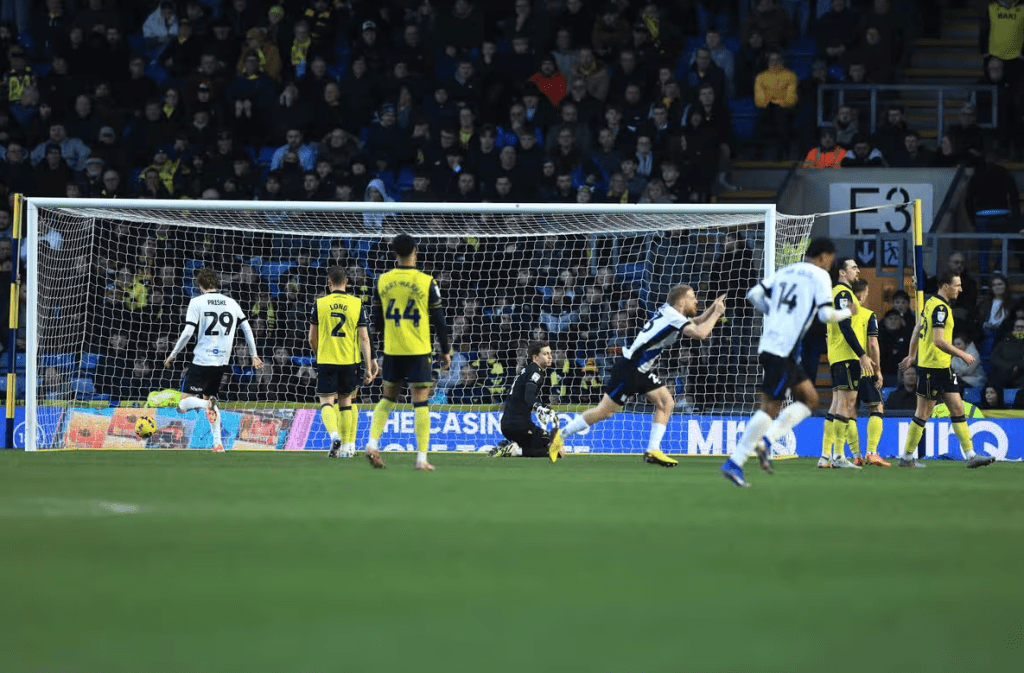
Eventually Brodie Spencer is drawn into a clumsy challenge, his momentum taking out Osman on the by-line. Seung-Ho places the ball a yard or two away from the challenge to give himself an angle and blasts a cross into a crowd of players which cannons off Peart-Harris and into the goal.
The goal’s simplicity is the biggest blow. The effect is like bursting a balloon; all the fears and insecurities return. Every step forward is followed by a yank back to reality. Nothing we do seems to be able to evade the tractor beam of relegation.
There’s basically no response, Jamie McDonell clatters Osman and gets a yellow card which neuters his attack-dog instinct and gets him substituted for his own protection.
The second half follows a similar pattern, Osman misses from a yard out before Marvin Dursch finishes off a move in which Birmingham play through our static midfield, then our static defence and then our static goalkeeper. Nobody’s angry, we’re just disappointed that we’d given ourselves so much hope.
After that, any semblance of style or plan slips away. There’s nothing spectacular about what Birmingham do, but we’re too lost in our own problems to really be affected. Even forays forward lack conviction and energy. On the pitch and in the stands, nobody really believes we’ll score, let alone take anything from the game. Whatever dark forces hold us back seem increasingly absolute.
The whistle goes and there’s silence. We’ll go again on Tuesday and Saturday and every game after that. But in these moments of contemplation, the realities are becoming more vivid with each passing disappointment.
Let’s not get too lost just yet; we’ve passed up so many opportunities to establish some momentum, but incredibly we still have a chance. Blackburn are in freefall, Sheffield Wednesday are doomed, West Brom are struggling while Norwich and Portsmouth don’t seem to be able to quite drag themselves to safety. We’ve still got to play all of them, four of which are at home. Plus, Leicester are waiting for a big points deduction, which could drag them into it and they’re a big old mess.
But, whatever happens this season, Matt Bloomfield has another task, to somehow extract a football club from the embers of whatever becomes of this season. After a solid first few games, yesterday exposed the bigger challenge. We’ve been firefighting for nearly two years, at times we look exhausted, both physically and mentally. New signings bring hope, but also unfamiliarity, we are teeming with players we can barely remember. Everything is focussed on the next game, every game feels like a steep hill to climb. There are great moments but they come with crushing blows. Wembley, promotion and the Championship novelty feels like a long time ago. We’ve become too focussed on the immediate issue and, perhaps, lost ourselves a little as a football club.
And this is where the hope could sit. Bloomfield gets it, his schooling at Wycombe under Ainsworth may help; to build a club that’s bigger than the sum of its parts. Putting the science and the data and the scouting in ‘new markets’ aside, whichever division we end up in, a renewed sense of identity is maybe the most important goal of all.
 Oxblogger
Leave a comment