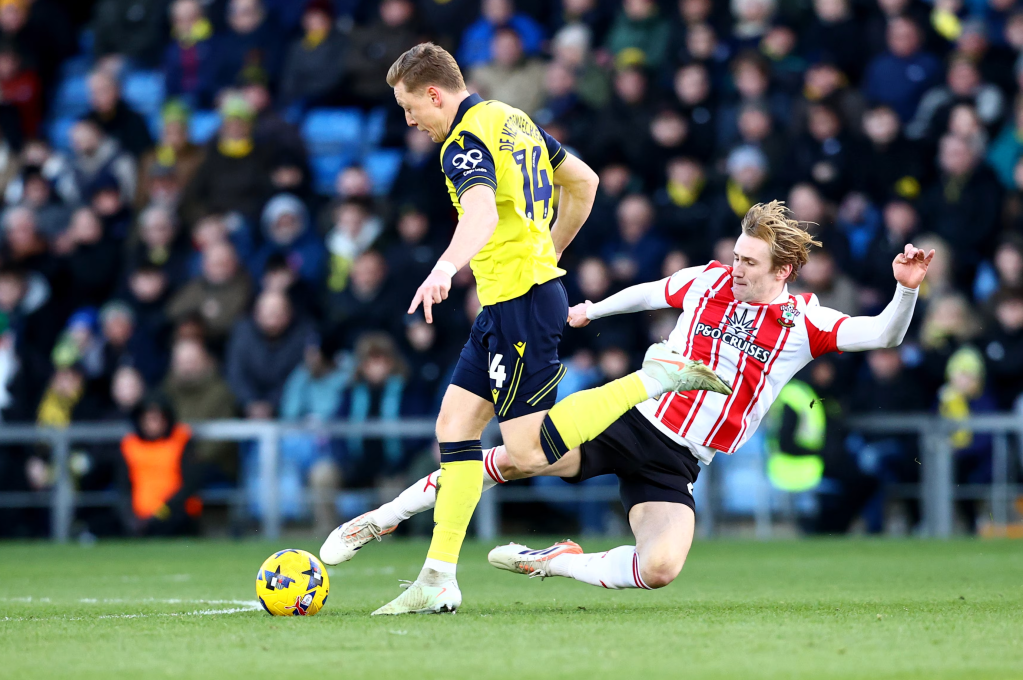
Oxford’s CEO Tim Williams was on the Price of Football podcast this week, for someone often criticised for his communication skills, he always comes over well when he talks. The podcast’s host, football finance expert Kieran Maguire, is as independently minded as it’s possible to be in the insular world of football, but he clearly rates him.
Williams made the point about how good the EFL ‘product’ has become. Some might bristle at the idea of football being sold as a package, but it’s true, we’re quick to criticise many things, some justified, some less so, but the EFL and the Championship is a universally entertaining place to watch football.
Boxing Day football is another great British tradition. It’s an opportunity to break out of the confines of your dehydrating, claustrophobic family conclave and breathe the clean air of the world beyond. Attentions are diverted away from each other – with all the troubling politics, judgemental behaviours and risible television selections – towards something else, a shared experience. A proxy for something that can’t be said.
There’s always a nice mix of regulars and those who just come for the spectacle; the visiting families and friends for whom this is a tradition, and the diaspora who follow the club from afar who are taking in a game as part of a visit home. It’s the ones who are less consumed by the nuances and side-plots of the club who lighten the mood and release the tension.
There was only one Premier League game on Boxing Day this year, an evening kick-off. I say we go further, give the great Christmas institution of Boxing Day football to the great British institution of the Football League. Let the Premier League, the bloated, all-consuming global self-serving blob take a back seat for once.
The external shell portrayed all the familiar traditions of the Boxing Day game, but beyond the bonhomie at the surface was an undulating lava of turbulence. Like a good Eastenders plot, this year Christmas served up a main character storyline with the removal of Gary Rowett and the looming threat of relegation. Throw in the visit of Premier League adjacent Southampton and we had plots and subplots for everyone.
Craig Short, the amiable constant during our transitions, made five changes, bringing in Currie, Mills, Placheta, Goodrham and Luke Harris. There was a story behind each one, talents which had been constrained by the gravity of our need to stay in the division. It felt like the decisions of someone not contracted to deliver a tightly defined output, a line-up for the people, free of the over-thinking that wracked Gary Rowett’s final weeks.
This was a side designed to entertain and engage, maybe to re-engage those who’d lost faith. Short conceded that he’s not strong on the tactical and technical side of the game; but tactics are just theories, hypothetical constructs designed to win games. They’re not, in themselves, a thing, they need to be applied and executed, sometimes they need to be ignored and sidelined because they don’t work. He under-estimates his strengths.
For once, the pressure was off, rather than playing to Rowett’s tight blueprint, the players could play. That’s not a criticism, it’s just a reality of the situation we’re in. Short’s future won’t be defined by these decisions.
We defended deeply when we needed to and attacked when we could. We tried and failed in a safe space; passing was a little looser, control was less crisp, but we didn’t lack application. At times the crowd fell almost silent as Southampton controlled the tempo and narrative, hogging possession looking for a gap or error to exploit.
Despite the pressure, we held firm, not just as a team, but as a club, we just had to trust that opportunities would come. It felt like a cup game, engaging with the moment, not thinking too far into the future, or reflecting of the disparities of the past, not trying to be more than we were.
After 20 minutes or pressure, an opportunity sprung forth, Goodrham broke on the left from Mills’ clever through ball and forced a corner. Goodrham took the kick himself, Southampton scrapped it away, but Mills had time to bring it under control and angle a long deep cross towards Michal Helik. Helik’s header was cleared to the edge of the box where Goodrham arrived to half-volley it through the crowded box into the right-hand corner.
The catharsis was tangible; Goodrham has spent the best part of a year trying to live up to the expectations of others – the fans’ belief he is the club’s great hope and Rowett’s doubts about his ability to step up. Sometimes you’ve just got to let the players play.
The lead didn’t last long, conceding a routine, training ground free-kick, which gave Harwood-Bellis a free header. It’s the frailty that jeopardises our long term viability in the division and something that needs addressing, but maybe not today.
Level at half-time, the game opened up after the break, Scienza crashed a shot off the post, Placheta responded with a long range volley that had the keeper scrambling, even though it lacked pace to be truly troubling.
Cumming saved sharply from Robinson at the near-post as we continued to absorb pressure. It was just a amuse bouche; moments later he spread-eagled himself as Armstrong found himself unmarked five yards out. Waiting for the ball to ripple the net, Cumming sprawled to block the shot with his feet. A few minutes later he completed a trilogy of excellent stops, parrying from range, but the close range block was the pick of the three. After the game, a small group gathered around the TV in the South Stand upper, each Cumming block was greeted with someone saying they’d forgotten his contribution. It was quiet, necessary and crucial.
One of the problems with Rowett this season is that his doubts about the squad became too high in the mix, Short judged less and expected more. He introduced Krastev and expected him to play. The Bulgarian responded, dribbling into dangerous areas, occupying Southampton, eroding time.
Then came Dembele, Short admitted the disciplinary issue had seem the winger frozen out had been with Short himself. It was a clever move, a signal to Dembele and to the others, that he believed in them, if they were willing to repay him by taking their chance.
The game entered its final moments, people started to leave, sated by an entertaining spectacle. The regulars began to breathe, satisfied with a point, avoiding humiliation was important.
As many slipped into the darkness outside, hoping the movement would feed the blood supply to their freezing fingers and toes, the game continued.
The injury time board was being prepared as we repelled another threatening attack. The ball fell to Stan Mills, a player who has embraced the club and plays with heart and spirit. He was clear with space to accelerate, he jabbed at the ball with his toe, conjuring it to his will, bull-dozering his way past the retreating Southampton defence.
The ball bounced off his shin and thigh and remained under his control, it rebounded off the jagged prisms that make this club what it is and remained in his path. When the ball threatened to run away from him, Will Lankshear settled it. Mills continued, he said he couldn’t remember anything about it, he’d transcended and entered a fugue state. He was free, sliding the ball beyond Bazunu’s despairing hand and into the net.
The release engulfed the retched regulars and the wide-eyed casual interlocutors as one, Mills flung his shirt into the sky and screamed into the throng. It may not be the long term solution, but the primal rage, the purge of frustrations gave everyone a cause for hope.

 Oxblogger
Leave a comment