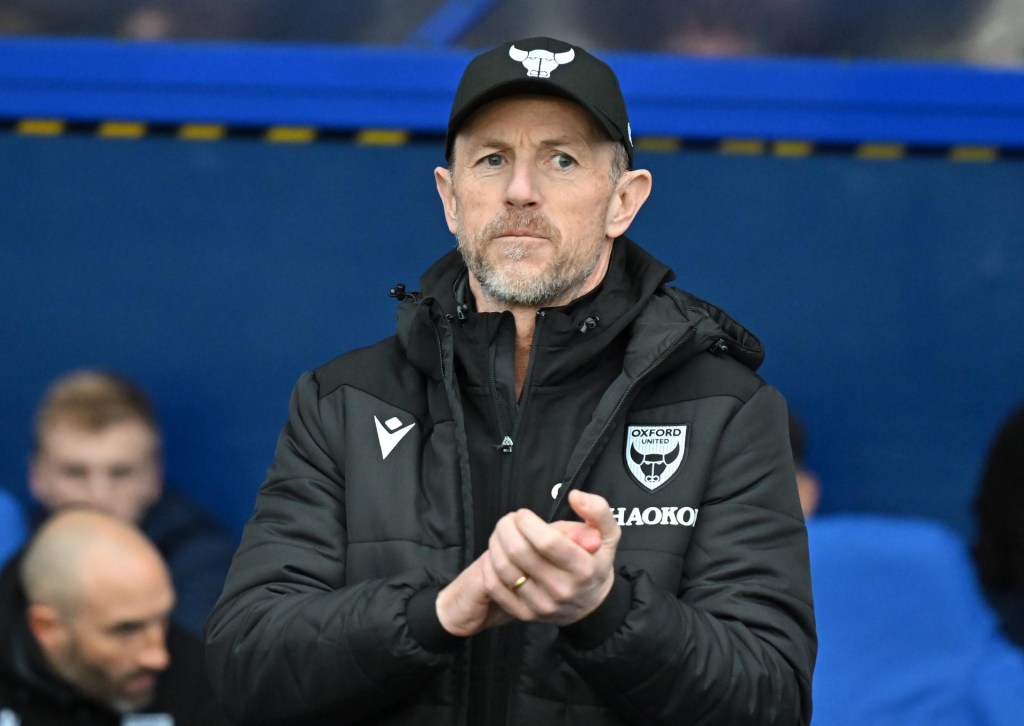
How will Gary Rowett be remembered? Probably differently to how he’s currently viewed. The decision to sack him comes just over a year after the decision to hire him – 368 days to be precise. In Oxford United terms, that’s a short tenure, putting the club’s recent record in line with that of Firoz Kassam, whose sacking sprees were considered a marker of chaos and mismanagement.
Promotion in 2024 had come on like a dream. Led by a dewey eyed, local boy done good – Des Buckingham and his rehabilitated an injured sparrow – Josh Murphy. Despite Murphy flying to Portsmouth, after strong start in the Championship, we were still feeling that hazy, fuzzy glow as we subconsciously drifted into the nuclear winter of a relegation fight.
The decision to sack Buckingham was a jolt. A wake up call from the club that we didn’t want to blissfully drop back to League One and regret the opportunity that had been given. Rowett was the experience hire; less idealistic, more realistic. We were even assured that his contract didn’t have a release clause if we were relegated. It was a slightly strange power dynamic.
The impact was immediate, a more deliberate approach brought two wins, but with opening home games against two relegation threatened sides – Cardiff and Plymouth – should we have expected anything less? Our first away win at Millwall on New Year’s Day completed a perfect Christmas. Rowett’s appointment had been fully vindicated.
January was strong, even though we sacrificed our place in the FA Cup, but then came the slump. Nine games without a win, Rowett’s explanations – more pundit than manager – grew thin. Equally, he wasn’t shy to play to the few strengths we had; the height of Michal Helik and the long throws of Will Vaulks.
The football became comically one-dimensional; the margin for failure was minute. But, while Vaulks hoiked them in and Helik caused mayhem in the box, we had a chance. A final flurry of narrow and unexpected wins saw us over the line, season saved, job complete. Rowett’s reputation was in tact, but it hadn’t been comfortable.
The aim was to put that right during the summer. Preparing for the Championship after a play-off win, particularly an unexpected one, was always going to be a scramble, now we had a chance to consolidate.
But Rowett never seemed fully engaged. He dealt with what he was given, a diverting trip to Indonesia, some cunning signings. It still felt like it was the club’s doing rather than Rowett’s, at least that’s what he seemed to want us to believe. While he seemed a generous, thoughtful and honest person, the detachment meant he was admired more than he was liked.
The serious heads would point to his record; he’s never been relegated (apart from at Birmingham when they were already doomed), our late season form would have seen us in the top 10.
It continued into the new season; stylistically there were improvements, results compared to their equivalent fixtures were better, occasionally we lit up; the 3-1 win at Bristol City was a highlight, 2-1 against Ipswich, his final hurrah. Mostly, though any improvements were just underlying numbers, the front-end failings were becoming more obvious; we weren’t picking up points, slipping towards the relegation zone, failing to hold onto leads, falling to struggling teams we should have beaten, above all, the prosaic style wasn’t having the same effect. It was always marginal, but now we were falling on the wrong side of the margin.
Already detached, Rowett began to detach further, he reminded the club that sacking a manager in the Championship was no big deal and criticised the summer of signings – too many attacking players – seemingly oblivious to the fact he was an employee of the club and not sitting on a Sky Sports sofa.
In recent weeks he’s sounded deflated, unable to come up with explanations for our performances, constantly changing the team, its formation and strategy. By his own admission, he’d run out of ideas, the decision to sack him probably isn’t a surprise to him, it may be a relief, it might have been what he’s been orchestrating for weeks.
So, how will he be remembered? Legacies tend to clip the final knockings of a managerial reign out of history. Karl Robinson will be remembered for exciting attacking football, Des Buckingham for a dream promotion, Rowett, I suspect, will be a man who came to do a job of keeping us up, did it, then left. Of course, it would have been madness for him to leave in the summer, but this season has felt like a contract extension he wasn’t fully committed to.
And, of course, nobody expected us to survive, so for Rowett to come in, replace Des Buckingham and achieve that goal is a remarkable achievement. Hopefully he’ll be remembered for that and not the end.
For the club though, we’ll be on to our fourth manager in just over two-and-a-half years. That’s not a great sign of stability, it means managers are picking up the squad legacies of their predecessors, Rowett’s successor will be taking on players signed by Karl Robinson as well as Liam Manning and Rowett himself. The club will argue that there’s separation between the role of manager and recruitment, but in the end, players are the tools of the coach’s trade.
Our next appointment is critical; either to steer us to safety or to limit the damage of relegation. With the stadium work progressing, matters on the pitch will compete with other priorities. Maybe we’ll survive and go again next season, there’s still plenty of opportunities to rectify the situation, but if we don’t, we’ll want to be more like Cardiff than Plymouth next season. The next few weeks may determine which it’ll be.

 Oxblogger
Leave a comment