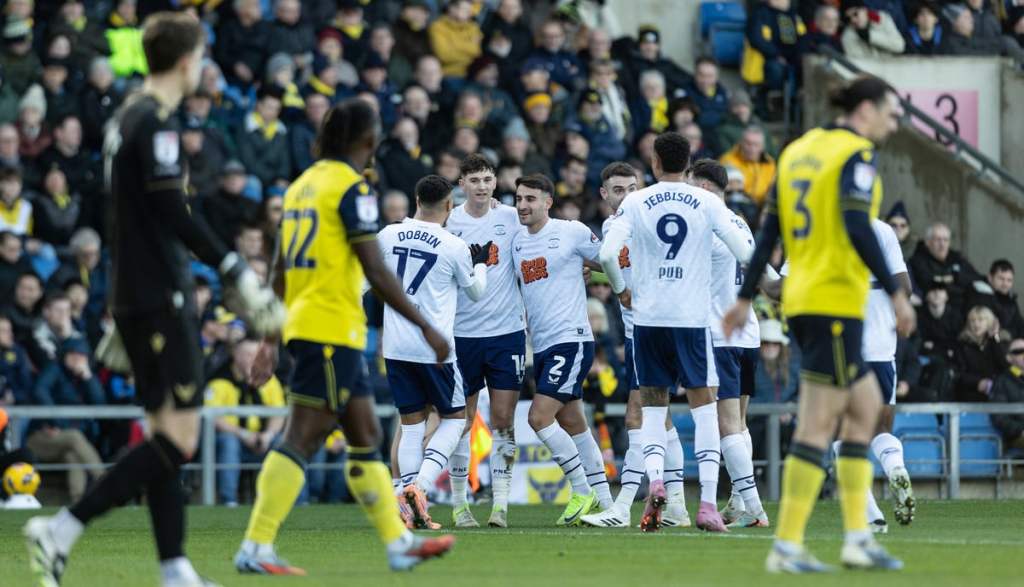
As we trudged towards the exit in near silence after yesterday’s 2-1 defeat to Preston, I looked to the back of the South Stand, a man of late middle age bellowed a single word: ‘Cheat’, his face was contorted with anger.
I looked down towards the pitch and could only deduce that he was directing his venom towards the referee. ‘Go on’ he shouted towards, presumably, whichever Oxford coach was nearest the officials, ‘Punch him. Punch him out.’
I assume this is out of character, I’m guessing that this isn’t how he handles the injustices of, say, a young family missing out on their preferred Christmas tree at the local garden centre. Being presumptuous, his place in the South Stand suggests a degree of fiscal success, so presumably other parts of his life aren’t conducted like this.
As far as I could tell, a cheating referee wasn’t high on anyone’s list of reasons for the defeat. We probably should have had a penalty when Greg Leigh was pulled to the floor and a brave platoon of South Standers had to remind the linesman about the rules of foul throws – to which he eventually responded – but cheating it wasn’t.
Screaming at the referee is shorthand for something more complex. And I don’t mean an ageing man’s existential frailties as his sexual impotence and growing irrelevance in an evolving world begins to take hold. If we unpack that singular frustration, the chances are we’d find a myriad of reasons and drivers.
The Swiss author, Elizabeth Kubler-Ross says; “There are only two emotions: love and fear… From love flows happiness, contentment, peace, and joy. From fear comes anger, hate, anxiety and guilt.”
The screaming of the word ‘cheat’ at a referee, or calling for the firing of Gary Rowett, as some are now doing, is an act of fear. It’s the fear of relegation, for sure, but by extension it’s the fear that we’ve deposited a large investment of time, money and identity which is about to crash and humiliate us.
The truth is the challenge this season doesn’t pivot on the firing or not of Gary Rowett. One of the wonders of a season is that it’s like trying to fix a Formula One car while it’s flying around the track. The season races by with things changing all the time, you can’t bring it into the pit lane, change the manager like a set of tyres, and start again at a more optimal level. So, you need to be careful that you’re not changing the manager simply as an act of anger.
Most clubs have de-risked the manager’s position, the days of Brian Clough running everything at Nottingham Forest are long gone. Gary Rowett subscribes to this; he and Mark Sale share a rented flat in Summertown because they know that uprooting his family to pursue a job which tends to last eighteen months to two years maximum, is pointless. In essence, they’re short-term contractors.
The question is, in a universe where the club is simultaneously trying to fund a stadium, develop its training facilities, recruit players, repair injured players, develop new revenue streams, build its brand, grow new talent, run the logistics of an 11,000 person event every fortnight and extend its women’s side, amongst thousands of other things, does the problem become the manager? Or is it that firing the manager is not so much the best option, but the only option in the name of ‘doing something about it’?
Yesterday was case in point; the atmosphere was strangely subdued. Perhaps it was the combination of an early kick-off, an apprehensive home following and an away support who can’t quite believe they’re in the play-off spots. Nobody really wanted to make a noise either because they were still digesting their breakfast or because they didn’t want to wake the gods of fate.
After a sleepy 25 minutes, Preston took the lead, a deep ball to the back post seemed to flick off Ciaron Brown onto Jordan Storey and deflect through Jamie Cumming’s legs. Even the reaction to the goal was strange; the referee seemingly feeling the need to indicate the ball had crossed the line when it was sitting in the back of the net. It was all a bit surreal.
The response was solid enough and we went into half-time a little frustrated that we were still behind. Then, they seemingly killed the game four minutes into the second half with a goal from Daniel Jebbison which looks well-constructed, but was aided in no small measure by our static defending.
For a side facing relegation, you’d expect us to collapse into a vortex of introspection, but instead something blossomed. De Keersmaecker’s response four minutes later igniting a fight back. Suddenly we were flying, Vaulks, Lankshear and Prelek all went close. As a second-half performance, it was one of the best of the year, but like against Leicester and Coventry, teams looking for promotion, we couldn’t find the breakthrough.
It didn’t look like the performance of a relegation side, we created chances, dominated most of the half, made Preston look normal, and yet it keeps happening. Rowett introduced Mark Harris and Tom Bradshaw who together have scored two goals in the calendar year, the momentum slipped away and we clunked into the relegation zone.
What went wrong? Did anything go wrong? Rowett doesn’t seem to know, but neither does anyone else. He keeps shuffling the pack to find a solution, but every time he comes up with one, something shifts – form, injuries, the opposition. I’m looking for a sign that a change of manager would make a difference, at the moment the only one I can see is Rowett’s dwindling motivation, how long can he cope with conjuring up new ideas and not getting rewarded for it?
Our recent form is better than it feels; bottom six rather than bottom three. It’s a stark contrast to the situation we found ourselves a year ago tomorrow when Des Buckingham was fired where we’d taken one point in six. Many, me included, didn’t think it was the right decision then, so how can we justify changing the manager now? It’s not a question of competence, as James Roberts from Behind The Badge said, if you fire Gary Rowett, you’d probably want to replace him with Gary Rowett.
Back to Elizabeth Kuber-Ross: “We cannot feel these two emotions together, at exactly the same time. They’re opposites. If we’re in fear, we are not in a place of love. When we’re in a place of love, we cannot be in a place of fear.”
Rather than channelling our fears and exacting our anger at Gary Rowett, perhaps we should be embracing the excitement of the challenge. If our fear is allowed to sit too long, it will likely see us regress and slip back further. But, only if we let it; somehow we’ve got to find a way to love the battle for survival.


 Oxblogger
Leave a comment