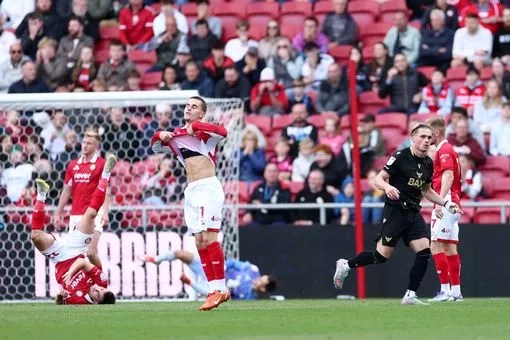
Sunday wasn’t my first visit to Ashton Gate, it wasn’t even my first visit of the week, having attended the Women’s Rugby World Cup quarter-final between England and Scotland last weekend.
The difference between men’s football and women’s rugby is more than just the shape of the ball and the gender of the players. In club football, pre-match routines have evolved over decades and the crowd is in complete symbiosis. At the rugby, those norms are still developing and the accumulation of non-aligned behaviours in unfamiliar surroundings means everything feels more chaotic with people mistiming their arrival, parking badly and getting lost around the stadium.
The exponential growth of women’s sport draws an interesting crowd. There are die-hards who have been there since before the surge, excited that everyone now gets what they got years ago. There are families attracted by the concept as much as the sport; empowerment, teamwork, health and strength, inclusivity and acceptance, it’s all part of the draw along with affordable tickets and a fun, non-partisan atmosphere. And then there are those who think they’re just watching a man’s sport played by women, applying their jarring norms to a completely different context – a chorus of ‘the referee’s a wanker’ at a WSL game is like a mosh pit at a jazz festival. Neither’s wrong, but they don’t go together.
People even look different, I lost count at the number of those huge insulated coats designed for wild swimmers. ‘Everyone’s wearing DryRobes’ said my daughter. “At football, everyone wears Stone Island.’ I could have cried.
Sunday’s pre-match was more routine. City designated it a family day, although early on it seemed like many had chosen to mark it by spending time with loved ones at home. In the corner, a home fan waved a Union Jack, his contribution to the nationwide campaign to protect families, women and children through properly funded social services, investment in women’s refuges and re-opening of Sure Start centres.
We arrived at the away end, which had broiled last year for Liam Manning’s judgement day with Des Buckingham. A steward looked sympathetic to my anxious search for a seat and advised that we could sit where we wanted as there would be plenty available. The game was admin for them and it felt like we’d accepted our subordinate role.
Despite the sedate preamble, there was something resembling a decent crowd by kick-off. These are good times for City, they’ve been building for a while and you sense they could capitalise on the instability in bigger clubs and soon sneak a promotion.
By contrast, our black kit, making its debut, made me nervous. Black suggests you’re a rogue badass and the gold detailing boasts that you’re a successful rogue badass, a bold message when you haven’t won all season.
Despite our slow start this year, times are changing, Gary Rowett’s go-to of defending deep and hoping to nick a late set-piece goal is giving way to something more proactive. His confidence stems from Brian De Keersmaecker, whose presence gives structure to what was previously a giant defensive sponge. At one point the Belgian sprinted from central midfield to cover Jack Currie when most would hold their position or assume they were out of range to help. De Keersmaecker’s quality is that he anticipates future threats and acts early. The fact he’s so committed to us makes my knees tremble.
One beneficiary is Shemmy Placheta, last season we expected him carry our attacking ambitions by providing trickery and producing chances. With a more robust structure in midfield, he can focus on weaponising his pace. His early threat dragged their back-line beyond their comfort zone before they found a dominating rhythm.
The speed at which we win and recycle the ball creates space. Phillips benefitted last week, his replacement, Nik Prelec, is direct and brutally strong. With Placheta occupying one part of City’s defensive brain, Prelec battered them out of shape until Zak Vyner and Adam Randell wrestled him to the floor to keep him quiet.
De Keersmaecker swung the free-kick in and Prelec threw himself through the defensive line to head beyond Radek Vitek for 1-0. Disbelief swept along the away end, the kill, so clean and swift, impressed not so much because of its execution, but the foundations on which it was built.
I resisted the goal’s seduction, clapping like a seal while bodies collapsed around me. We’d been here before, literally here, one year ago to the day we’d been full of optimism and bravado and were a Ruben goal to the good before coming away with nothing.
Rather than wait for a response from the home side, we built; Lankshear went close and we defended with commitment through Helik and Long.
After half-an-hour, Brodie Spencer confidently shepherded the ball out of play but a glancing touch to concede a corner. It swung into the sun beyond Cumming and towards the back post, its trajectory and geometry signalled a certain goal. My brain prepared for a wave of noise from the home fans as it hit the back of the net. My eyes fixated on the ball, Spencer appeared in my peripheral vision, midair, acrobatically clearing from under the crossbar. A stunned silence beset the away end, there was barely a smattering of applause, it was like we were still mourning the phantom goal, even though we’d witnessed Spencer’s miraculous recovery. The game moved on before we could finally allow ourselves time to believe what we’d seen.
As we grazed first-half injury time, we won another corner, securing the belief that we’d go into the break with a lead to defend. De Keersmaeker’s delivery deserted him and the ball was easily cleared. Collectively, our mind shifted towards toilet queues and snack bars.
Almost incidentally, the ball fell to Placheta five yards outside the box, he swung his boot instinctively, detonating the ball, projecting it at a savage pace that defied physics. The net convulsed as it entered the top right hand corner. Despair was layered upon despair for the increasingly scratchy home support. Placheta willed his body to celebrate, but it wouldn’t comply, almost like it thought what he’d done was a hallucination. It wasn’t, 2-0 was something substantial to defend.
Needing to maintain our tempo, after half-time we threatened to extend our lead further when Long hit the post. Two minutes later Anis Mehmeti shredded a ferocious strike beyond Cumming. The goal re-kindled their ambitions, the crowd jolted at its quality, fate seemed to bend in their favour. We weathered the next ten minutes, scrambling to re-establish our footing. City may have been unbeaten, but this resistance was new.
Our substitutes, which often weaken our foundations, instead offered a refreshed threat. Mills’ impact was instant, benefitting from a vigorous half-time warm up which ensured he joined the fray at match pace. Dembele bounced off defenders and infiltrated their tiring minds. As we anticipated a tortuous injury time, Rob Dickie dragged him to the floor.
Defending a one goal lead away from home in the last minute might normally be reason to take the ball to the corner flag, instead we lined up to attack. De Keersmaecker’s cross had pace, but lacked height. Greg Leigh dropped into the near post, contorting to encourage some kind of contact. I was in line with the ball, at best he swished his ponytail at it. It continued unabated across Vitek and into the net. As the ball rested, I was consumed, strangers and generations bridged to embrace, someone high-fived me, screaming in my face. I could feel their breath, a faint cocktail of sweat and stale beer lingered like cut grass and a sweet morning dew. I was at one within the maelstrom.
The greatest gift is a goal that confirms a win and leaves you time to savour it. Ashton Gate emptied as eight minutes of injury time brought a carnival. What should have been a day of routine, had become anything but.

 Oxblogger
Leave a comment