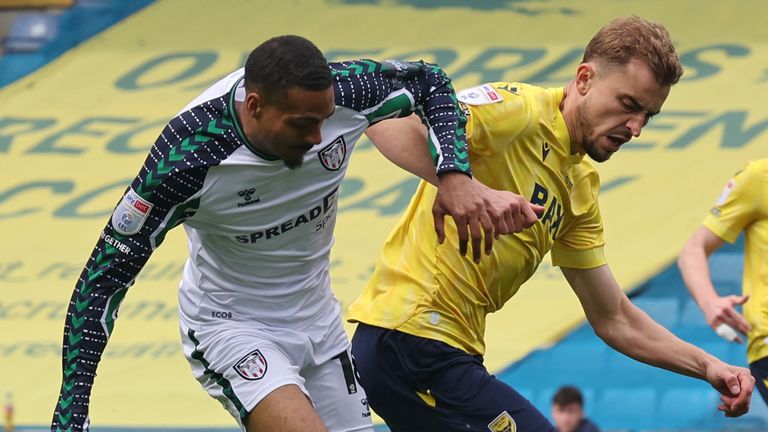
On Friday we enjoyed an impromptu drink with friends. After exchanging news and informing one of our number that the Pope had died (her response: ‘Fuck off, when?’), we eased the gnarly pressures of the week by treating ourselves to a takeaway.
It was my turn to pick up, I stepped into the fading light and onto the deserted road. The silence dragged me out of my sanctuary, it was like being hit by a crosswind, blindsided by a noxious feeling; our day of reckoning was closing in.
For days and weeks, our fight for survival in the Championship has infested my dreams, sat with me through meetings and been an unwelcome condiment to every meal.
If the league table were to manifest in physical form, it would be the kind of indecipherable curiosity you see in a museum. The sort of thing that could equally be used to ram suppositories up your bottom or shoe a horse.
The league is an intricate mechanism of moving parts – points, places, goal difference, away form, home form, games in hand. It’s a hypnotic din of clunks and clanks, constantly shifting, mesmerising us with clues but no definitive answers. Even when you’re not involved, it has the power to consume you, inducing an endless circular computation of what ifs and maybes; if X beat Y, they’ll go above Z, but Y play Z next week and they can’t both win. So, if X and Y draw then Z will go above them on goal difference…
On and on it goes.
The genius of the league system is that even after more than 800 hours of football, it rarely resolves itself fully until the season is complete. It’s a wonder of Victorian engineering, a fully functioning anxiety machine.
Modern science has tried to rationalise its outcomes, statisticians at Opta calculated that we had a 5% chance of going down, which was like being given a medical referral for a serious illness; 5% feels like a big number when the outcome is catastrophic.
Cold rational logic said we’d stay up, but did that factor in the tsunami of form that ingulfed the bottom half of the table during April? Between January and March, the bottom nine teams in the division accumulated, on average, 52 points a month, in April that leapt up to 75. In short, everyone was winning.
Logic responded by releasing the barely conceivable fact that since Gary Rowett arrived, we’ve become a form side in the division. But, in January, we accumulated 12 points and in February and March combined just six. Seven points in April suggested a returning to form, but an abject performance against Cardiff indicated we might be running out of steam.
The fluctuations plagued our thoughts as the Sunderland game approached. Which Oxford would turn up? Which Sunderland would turn up? What would happen elsewhere? Before the game, news filtered through that Luton had got a last-minute winner against Coventry. The goalscorer? Shandon Baptiste. Oh Christ, why did nobody keep an eye on The Narrative?
Rowett tweaked the starting line-up with Sam Long replacing Peter Kioso and Ruben Rodrigues and Mark Harris coming in for Tom Bradshaw and Alex Matos. Most likely, he was injecting some energy into the side, but it felt symbolic; the three replacements got us up last season; it would be up to them to keep us there.
Paraphrasing Franklin Roosevelt, the greatest fear is fear itself. If the distant clanking of the division became too much of a focus or the fear of what Sunderland could do became too consuming, we would surely freeze.
Before the game it felts like we might have done just that. There were no fireworks before the game, no flag waving parade for the players to come out to and just three mascots of which one wore a Sunderland kit. Was that because this was strictly business? Were we gripped by fear? Or simply inept?
Fears subsided as Rodrigues and Harris quickly settled into the role of pack animals pressing the Sunderland backline and blocking balls into midfield. The energy and aggression set the tone, a stark contrast to recent games where we’ve looked lacklustre and sought salvage from Will Vaulks’ throw-ins.
I don’t believe the ‘on the beach’ thesis where teams shut down, but I do believe it takes 100% effort to make a 1% improvement. As Harris and Rodrigues harried, Sunderland’s will receded, we were gaining the upper hand.
Cameron Brannagan’s rasping drive after five minutes was tipped over by Anthony Patterson; we looked dangerous and robust. This was the more palatable version of Rowettball we’d seen in January; disciplined and precise, but with movement and threat.
The initial energy subsided allowing Sunderland to exert some pressure, from the stands, a thunderous rhythm struck up, we were defending as a unit on the pitch, and off it as well.
It wasn’t just the zealots in the East Stand desperately dragging an atmosphere out of the Kassam, the rhythm rolled through the South and North Stands building a steady and sustained wall of energy that was focussed, targeted, calm and fearless.
After half an hour, as things evened out, Vaulks’ free-kick launched towards Ben Nelson who rose like a super yacht effortlessly gliding into port. As his firm header hit the back of the net, the division clanked into action, the ballast at our feet was released and we floated into mid-table safety.
The goal wilted any Sunderland menace; the effort required to come back had increased ten-fold. There was no incentive to do that against a side committed to controlling its own destiny. We defended compactly, the crowd filling any gaps, the yellow wall held firm.
Moments into the second half Cameron Brannagan’s fierce free-kick was parried into Michal Helik’s path to force in the second. In recent weeks we’ve been like a band at the end of the concert introducing the individual musicians, giving them a moment in the spotlight to do a solo before returning to their tight rhythm. Sam Long, the homegrown stalwart against Sheffield Wednesday, Brannagan, the talisman against Cardiff, now Nelson and Helik, the foundation of our success this season.
Everyone combined to create a whole greater than the sum of its parts. Oxford Analytics on Twitter highlighted that scoring 15 goals from set pieces is more cost effective than buying a Championship striker to do that in open play. For all Rowett’s coldness and distance, it’s hard to argue his logic.
But, logic alone wasn’t the answer, as injury time came and went the three stands of our inadequate stadium rose to engulf the game in a cacophonous bowl of energy. Sunderland blurred into the background, the fourth best team in the division were made to be an irrelevance.
The remaining minutes induced a peculiar feeling; objectively we were in control and comfortable, the table had settled. And yet, equally, it felt like our toes were on the verge as we were looking into a bottomless pit. It was like Wembley all over again, the performance was more complete than we allowed ourselves to believe. The euphoria emerged as a rolling satisfaction rather than an instant hit, but the effect was no less great.
At the final whistle, the players disappeared down the tunnel, re-emerging out of their footballing personas with their partners and children. On the sidelines, backroom staff hugged, partly in celebration, presumably in relief; the financial benefits of the Championship will keep many of them in jobs next season.
For fifteen minutes, the players wondered around aimlessly, the wives and girlfriends nervously watched as their toddlers bolted for the fence end and the freedom of the car park. Someone produced some footballs to allow toddlers to have a kick-around, a couple of the players sat on the pitch chatting. Plenty of fans stayed behind, many trying to calculate just how many McEachran’s there were.
The scene was a sweet reminder that for all the effort, frustration and drama, there’s a real human spirit at its heart. The players score goals and defend blocks. We travel the country, encourage and validate their effort while putting undue pressure on them to perform, the families cope with the fluctuations in form, the injuries, the doubts and the fears.
The Championship offers a different drama, one that requires commitment and attention over the long term. Its reward is in the moments, like finding truffles in the dirt; Brannagan’s goal at Cardiff, Long’s at Sheffield Wednesday, Dembele against Sheffield United, and equally, seeing those people who make it happen on and off the pitch rewarded.


 Oxblogger
Leave a comment