Tomorrow marks the 20th anniversary of Real Madrid’s La Liga game against Villareal. Madrid won 2-1; which is unremarkable apart from the spotlight it shone on Zinedine Zidane’s genius.
Tightly filmed from multiple angles, cameras tracked every second of Zidane’s game. The footage became the film Zidane: A Portrait of a 21st Century Footballer. It’s no polished Netflix hagiography; there are no talking heads, no indulgent tours of his houses and cars, you see almost nobody else apart from Zidane. It’s a claustrophobic study of his analyses, calculations and genius told only through his facial tics, twitches and glances. The film starts the moment he steps on the pitch and ends as he descends down the tunnel after being sent-off in injury time. There’s no other story.
Yesterday, as the singing became less committed and people started to sit in their seats, I scanned across the banks of Oxford fans and my eyes rested on Jonny Biscuits, one of the avuncular co-hosts of the Oxblogger Podcast. I hadn’t spotted him before, but as people retreated, he stood out alone, his yellow jacket putting him in contrast to those around him.
He was motionless with a fixed gaze; like he was watching a house fire; hopeless and helpless, but defiant in the face of an emerging catastrophe. Next to him was Rosie (aka Gingermoods) slumped back, her face partially covered by her hands.
It wasn’t just them, it’s just their familiarity brought them into my focus. I was too far away to call out, but to do so would have felt intrusive. There was no anger, no gesticulation, no primal rage, theirs was a cocoon of despair. It was a feeling of numbing foolishness, the naivete and false belief that we belong here. Why do we make these investments of time, money and emotion? Why do we allow this, of all things, to define us? Theirs was a portrait of a 21st Century Oxford fan.
On the pitch, Tyler Goodrham skipped a challenge buying himself a moment of freedom, for a split second he looked like the player we want him to be. The Championship will teach him many truths that will make him a better player, but it will dim his light and make him more cynical. As if to prove that point, Sivert Mannsverk scythed him to the floor.
As others retreated, in a pocket of quiet and calm, Cameron Brannagan stood over the ball with Goodrham alongside him. The king and his heir. If Goodrham has learnt the ugly stuff, he’s about to learn what it means to lead. Brannagan speaks.
“It’s too straight, I’m just going to hit it.”
Gary Rowett has almost admitted we’re not a Championship side as he defines one. He lamented afterwards that we don’t have the athleticism we need to play twice a week, let alone twice a weekend. He’s probably right, as a promoted team we’re an outlier, other successful sides we’ve seen in League One are characterised by their robustness. We were svelte by comparison, lythe and exciting, but in this company that’s like taking a pedalo deep sea fishing.
Questions might reasonably be asked further up the food chain, were we too intoxicated by our success last summer? Too eager to spend money, secure signings and be praised for it? Too naive to the real challenge? Too wedded to our own narrative?
Equally, has Rowett over-compensated? Not just taken us back to first principles, but somehow back to Year Zero, The Great Reset, Control, Alt, Delete.
I’d gone into the game not wanting to be distracted by other scores; planning to check my phone no more than every fifteen minutes. This was fine until a human vidiprinter behind me started announcing a blitzkrieg of goals, each one providing a direct hit on our ambitions.
On the pitch we started slowly and retreated from there. Within two minutes, Ben Nelson stood motionless with the ball at his feet, devoid of options. We looked petrified. Were we planning to try and do this for ninety minutes?
Callum O’Dowda gave them movement down the left, attacking a gap that Peter Kioso seemed to leave as he drifted inside to cover the ghost of some previous existence. Shemmy Placheta had to take evasive measures to fill the space. A chance went begging, we were a mess.
Placheta, who possesses the athleticism Rowett wants, grew more frustrated as he became increasingly tethered to our rearguard. His skulking gate grew more hunched until he flew dangerously into a challenge that drew a yellow card, which could have been more.
By half-time we looked relieved of options; no plan, no hope, no future. Will Vaulks’ throws had lost their shine and Placheta had to be replaced for his own good. Everyone around us was winning, this was football inspired by irritable bowel syndrome.
Cardiff’s own solution to their problems was to install Aaron Ramsey in place of Omar Riza for the final three games of the season. Ramsey won’t bring new tactical nous to his side, but the removal of Riza dissipates the anger, tension and frustration being felt around Cardiff. Ramsey has a story that everyone can galvanise behind.
Just before the hour Yousef Salech bested Joe Bennett to head beyond Jamie Cumming for the opening goal, the hints of trouble became a disturbing bedlam.
The fans retreated into the safety of their own thoughts, elsewhere the goals flew in, we were carrion on the roadside waiting to be picked up.
With twenty minutes to go, Mannsverk felled Goodrham 35 yards from goal. Helik and Nelson went forward, the others hoped to peck at the scraps they might provide.
We’d been taught to ignore our past, clear our thoughts and forget who we are. The division doesn’t care about our narrative. Brannagan assessed his options, it was too central, a clipped ball into the box was too predictable and passive.
This was bare knuckle reality. The great Czech middle distance runner Emil Zatopek lived by the motto ‘today, we die a little’; a reminder for us all to live. For Brannagan, this has always been personal; he’s given plenty and sacrificed more. He could have played at a higher level, he might have earned more money, he may have had less turbulence by joining the ensemble cast of Championship journeymen, but he chose not to. In return, we give him something, for whatever reason, he chose us.
“I’m just going to hit it.”
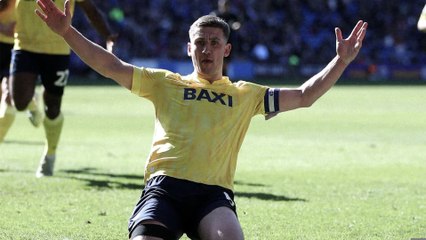
Brannagan has the authenticity, authority and history to lead. He’s earned this right to break the rules. Goodrham rolled the ball into his path, his boot connected, the force reverberating through the mangled tendons in his knee. Physiology and logic cast aside, this was a decision bundled up with history; with risk, fury and anger. When it left his foot the ball was placed in the hands of destiny, shredding the calcified fear that was haunting us. It swerved viciously towards its target. In the Cardiff goal Ethan Horvath reached hopelessly, the ball flew beyond his fingers into the net. In the commentary box Jerome Sale shedded decades of balanced BBC moderation to scream ‘Oh. My. God!’.
I look across; but couldn’t see Jonny or Rosie anymore, I couldn’t see anyone, just a jumble of bodies, a confusion of thunderous joy, a wildfire of hope engulfing the rotted despair. Puce faces and triumphant fists fused into focus before disappearing from view again. We’ve died a little today, but at this moment, we lived again.
Brannagan’s rage scorches everything in its path, he grabs at his shirt, unleashing his inner torment, he wants to do more. It shouldn’t mean as much as this, but it does. Like Sam Long’s goal against Sheffield Wednesday, it’s those who choose to be different that make the difference. I just hope it’s enough, not for us, but for them, because they deserve it more than anyone.
 Oxblogger
Leave a comment