Share trading is all about buying stocks at a price less than their true or future value, and selling them at price which is higher than their true or future value.
At the start of the millennium, internet stocks were all the rage. You could basically set up a website and sell shares to investors based on little more than a promise that at some point in the future they would somehow be rewarded with massive profits. You barely needed to explain how or when those profits would be generated.
Shares surged creating a frenzied bidding war, investors didn’t want to miss out on this new phenomenon and were prepared to pay any price. Some of these sites were valued amongst the biggest companies in the world.
And then investors began to panic, they’d ploughed millions into a series of vague ideas that didn’t generate any money. They wanted out, share prices tumbled as a grand sell-off began. The companies themselves were caught up in the spending frenzy, but the money dried up. The so-called ‘dot-com boom’ imploded in the most spectacular way possible.
Before last night’s game, Sky re-ran highlights of our opening day win over Norwich. There was Mark Harris looking all confident opening the scoring, Sam Long laying the ball off to Cameron Brannagan for an emphatic second, Des Buckingham, all sparkly eyed, applauding the fans at the end. It felt like another age.
I distinctly recall Jobi McAnuff declaring that we’d ‘be fine’ this season. It was an investment in hope rather than reality. Having prepared for a long and painful slog, we went into the next few games with a spring in our step. Being competitive in defeats was enough to convince ourselves that we’d indeed ‘be fine’. In short, our perception share price was booming even when the reality was not.
And then came the pop, heavy consecutive defeats, spiritless concessions, the delusionary idea that one win in sixteen was a passing moment. Reality hit and our share price tumbled.
Gary Rowett’s appointment arrested the slide, turned things around, we got sensible. We focussed on the basics; it was like appointing an administrator who sells the executive jacuzzi and starts focussing on simple ideas like revenue and cost.
The share price stabilised and then picked up, we relaxed, even Rowett, the arch pragmatist, declared us to be a mid-table side. But we started to slip again, prior to Norwich, we hadn’t won in seven and scored just three goals. Did we have enough cash in the bank to get us to the end of the season safely?
Losing to Portsmouth was particularly sobering. If we couldn’t beat them, then who would we beat? West Brom reminded us that at our heart we’re still a little fish with big dreams.
The consensus after Coventry was that something had changed. We’d scored, for one thing, and, for another, we’d scored again. But there was also a bit of renewed determination, a spirit, commitment and focus that had been absent in recent weeks.
In essence our perceptive share price appeared to have bottomed out; hope and speculation faded into the background again and realism appeared. Our dreams are our dreams, but if we didn’t address the realities in front of us, then we could fall apart completely.
Norwich away didn’t help, they’ve had a rollercoaster season; on the opening day they were in chaos. Winger Jon Rowe refused to play and there was already disquiet about their new manager, Johannes Hoff Thorup. Things have stabilised since with the goals of Josh Sargent and they went into last night looking to put themselves into play-off contention.
Both teams, therefore, seemed to be performing to the level we’d expect of them – both share prices had stabilised. Us, resolutely relegation threatened, them, a side committed to finishing about sixth. It would take a brave person to speculate against a routine home win.
We started well. Ole Romeny managed to fashion two half-chances in the opening two minutes, we were mobile up front, aggressive in the tackle and, after seven minutes, a goal down.
Sargent had already been touted as the most dangerous striker in the division. Outpacing Elliott Moore isn’t an automatic signal of that, but when he swept home Fisher’s cross it certainly felt like he was fulfilling that prophecy.
In celebration, Sargent lifted his hands above his head and made a heart sign with his fingers. Who is he? Ariana Grande? It was without doubt the most despicable thing an American has done in the last month.
Perhaps they felt like they were home and hosed after just seven minutes. It wasn’t unreasonable, it was already beginning feeling a bit West Brom-ey. But, we didn’t capitulate, when we might have done. We didn’t need some tactical masterclass to dig in. Our lack of creativity meant that we needed to capitalise on set pieces. But, we struggle even to get close enough for free-kicks and corners, so a lot depends on Will Vaulks’ long throws.
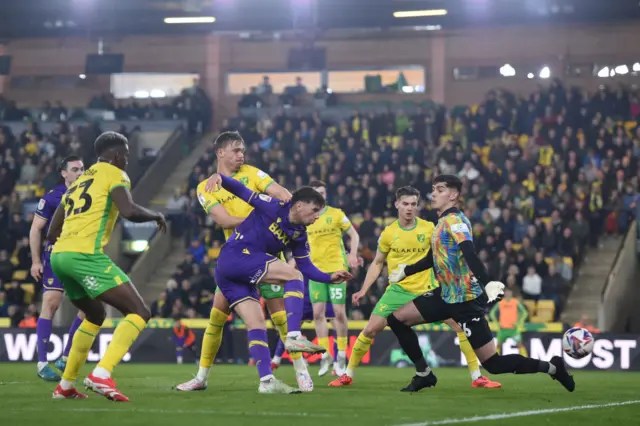
After 17 minutes he launched one into the box, Jack Stacey headed the ball into the back of Anis Ben Slimane’s head, and it dropped to Mark Harris, who would would have been offside if it had touched an Oxford player. Harris, who needed that moment of fortune, swivelled and fired in the equaliser.
It was his second goal in thirty-two games. He jogged away pointing at an imaginary watch. It was probably self-deprecating, but it looked like he was telling us we needed to be patient. I would have preferred him to lift his shirt, Mario Ballotelli style, to reveal the message: ‘Why never me?’
The next 72 minutes developed into the template we’d always expected. They attacked and probed, we dug in and fought a desperate rearguard. But they had something to lose, whereas, in real world, we had little more to gain. If anything, as the game progressed, the desire to protect the point simplified our purpose. On the pitch, on the bench, in the stands, and on the settees of our great shire, we all knew our purpose was to defend what we had.
The frustration of our lack of creativity dissipated, it felt like the end of the play-off semi-final against Peterborough. The roles were set, we were in a zen state. Like he did that night, Jamie Cumming pulled a top draw save in the last minute. It was a point, but it was enough.
As the old joke goes, the start of the season is all hope and no certainty, the end is all certainty and no hope. Our perceptive share price has settled, we don’t need any over-inflated speculation of our potential or evaluation of our purpose, we needed about six more points and now we need about five. If we can retain the same focus to achieve what’s achievable, as we did last night, we’ll be OK.
 Oxblogger
Leave a comment