There was a Christmas extravaganza behind the South Stand on Saturday. Not just a regular vaganza, an extra one. As we walked through it, the band launched into In The Bleak Midwinter at a mournful adagissimo tempo.
As the sorrowful trumpet drifted across the chill air we walked past an eight-foot Father Christmas whose legs made up two-thirds of his body. He was telling a small cowering boy that the reason he was so big was because he grew with expectation. Did he mean in grotesque and disproportionate ways? Are metaphors real or do we seek them out?
Elsewhere there was someone dressed as The Grinch, a character who famously tries to steal Christmas and heap misery on his community. There were two seven-foot elves speaking in child-like voices, pretending to be something they’re not. Children milled around, if they still believe in Father Christmas, I bet they wish they didn’t.
Christmas is supposed to draw you into this duality; a melancholic stupor where we exist in a vague space between happiness and sadness. Children believe in miracles and fairytales while the adults look on knowing their naïve belief will eventually be crushed. We are happy that they’re happy, but sad their happiness will soon turn to sadness.
Our own crusher of expectations has been lowering for the last few weeks, there’s a creeping sense of inevitability. We’ve become like those amateur runners who sprint off at the start of the London Marathon so they can say they led the race for 100 metres before dropping back to form the grupetto at the back with the man in the diving suit whose time is measured in days not hours.
Sheffield Wednesday was neither a shoo-in nor a free hit, but they were a League One peer not that long ago. A year ago they had that same sense of drowning we’re feeling now. They were also eight points from safety with four less points than we had. And they survived.
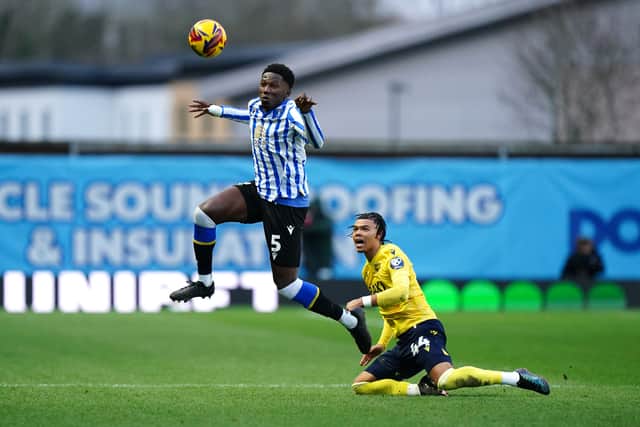
Of course, they’ve got the shit-pixie Barry Bannan, the strange little ageless man who lives in a peculiar space of lower league geniuses. Too good for his level, not good enough to go higher. Think: Lee Trundle or Peter Fear.
Bannan has been released from the responsibilities of the normal realm and given the freedom to drift around the midfield doing what he likes. Eventually, he’ll be freed of the constraints of his earthly body, but you suspect Wednesday will still play his wispy ethereal spirit in the centre of midfield.
But, while the ball ping-ponged between Bannan and players who weren’t Barry Bannan, we seemed keen to shake the fug of the QPR defeat by attacking with a refreshing freedom. Owen Dale was keen to make an impression while Dane Scarlett didn’t look as haunted as Mark Harris has in recent weeks. It all felt OK.
Wednesday weren’t quite there for the taking, but they showed an openness and vulnerability that gave us a vague notion of promise. The opening goal wasn’t so much well worked as a series of fortunate events. Brannagan’s ball into the box lacked any real intent, but Moore got his head to it and Leigh stretched to guide it past James Beadle.
Silly us, of course it’s all going to be fine, we’re the Christmas miracle, we’re A Team Like Oxford.
One of the novelties of life in The Championship is that the giant scoreboard behind the goal now shows replays and clips of the game in near-real time high definition. As we drew up a snuggly blanket of false security, I became distracted by it. It wasn’t so much what it chose to show but how. As we lined up for a corner there was a shot at pitch level from the East Stand. Except there were no cameras in the East Stand. In fact, there were no cameras in the ground at all and yet we were still able to relay the game in super high definition from multiple angles. Genuinely, watch the angles in the highlights then try and spot the cameras that took those shots.
Just as we debated whether this was Artificial Intelligence or a strange use of state-of-the-art Chinese spy satellites, we conceded. A corner from Not Barry Bannan flicked off Dane Scarlett into the path of another Not Barry Bannan who poked home the equaliser.
The reaction from the Wednesday fans was oddly muted, not so much a celebration as a recalibration of reality. The inflated metaphor of the Christmas extravaganza, the spiritual realm of Barry Bannan, the hallucinogenic images on the scoreboard were replaced by the truths of the earthly realm.
For a while there was a sort of parity, the game became so open you imagine the data nerds were struggling to find categories to define the play. We had one chance which involved an interchange between five players. You might describe it as fluid and intricate, but each pass seemed fortuitous and each player passed because they were more reluctant than the last to shoot.
Slowly we were the iron grip of reality, Wednesday are full of physically intimidating players, presumably this is what allows Bannan to be a bon viveur in midfield. Marvin Johnson, once of the parish, is a full-back that’s built like a welterweight boxer, we were living in the land of the giants.
Just after half-time Elliott Moore cleared a cross from Not Barry Bannan which landed at the feet of Cameron Brannagan. Brannagan had earlier shirked a tackle he’d surely have gone for before his injury. Here he failed to adjust his feet, knocking the ball to Not Barry Bannan to poke home.
On the hour, Bannan laid the ball off to Not Barry Bannan outside the box to drive it just inside the post in what is becoming an almost weekly ritual for Jamie Cumming.
Thoughts became entangled, but couldn’t consolidate, then it started to come together. It makes sense because it makes no sense. We exist in multiple places at the same time; we accepted that it would be a struggle to compete in The Championship and yet we hadn’t reconciled what real struggle would feel like. There’s misery and frustration in one realm, there’s a strange joy in another and threaded through all of it is a solid unity.
Afterwards there was talk about our squad being full of ‘League One players’ and that we needed ‘Championship players’. This is not the real world, players aren’t compartmentalised like that. Players are just players who have ability and get better or worse depending on a range of factors. The cycle of the season tricks us into thinking that we’re failing, but our squad is better than it was twelve months ago, it’s just that we’re consistently playing better teams. Do we throw that progress away in a vain attempt to survive or treat the season as a building block, a learning experience and an adventure? These thoughts of fatalism and realism will linger for as long as we exist in these multiple states of being.
 Oxblogger
Leave a comment