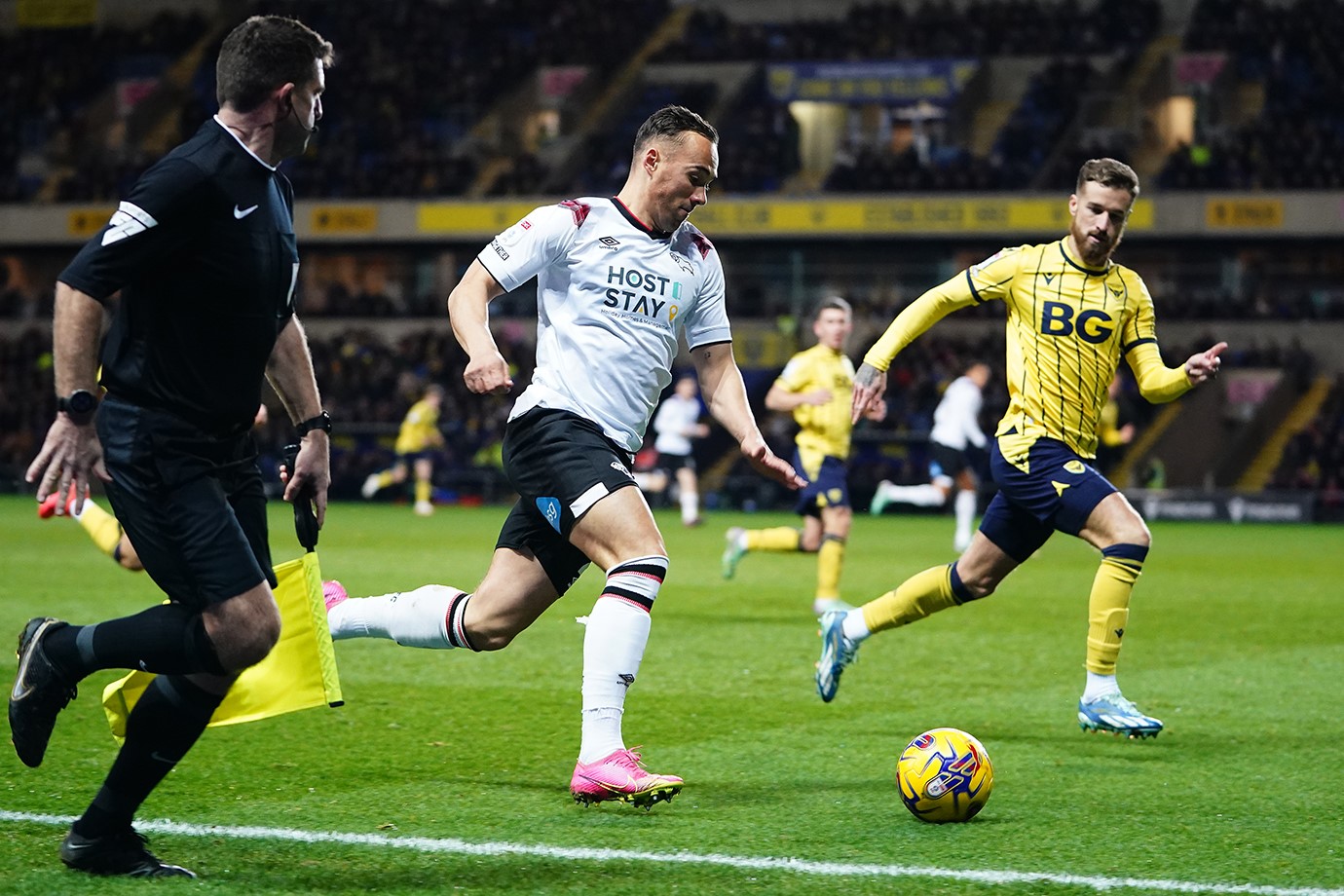
Amidst the unbridled orgy around him, one man stood at the centre spot, his foot resting gently on the ball. Derby striker, James Collins, looked at his team mates trying to catch their eye and draw them into his thinking.
The preceding 90 seconds had seen Derby keeper Joe Wildsmith stranded in his box as Mark Harris latched onto a long Brannagan through ball. Perhaps startled by our aggressive start, a stark contrast to the controlled passiveness of recent games, Harris had a moment to potentially lob the keeper for a goal in the opening minute.
Wildsmith doubled down on his positional error by swinging a boot at the ball as if to feign a clearance. With the ball at shoulder height, he simply clattered Harris and brought him to the floor. All that was left to do was the admin of a booking and for Brannagan to despatch the penalty.
Scanning for a response, while Oxford players trotted back to the centre circle, Collins pushed the palms of his hands towards the floor as if trying to supress the detritus of fury and confusion and find clarity.
Calm down.
Eleven minutes later, Stan Mills danced through the clodded hooves of the Derby defence waiting to feel a touch, his quick feet inevitably drew another clumsy foul and a free-kick. Brannagan directed his strike beyond Wildsmith for number two.
It never felt like enough, in between Brannagan’s two obscuring monolithic data points was the real game. In the eleven minutes between the goals we were pinned into our own box, withstanding heavy fire. We conceded a string of corners, if Paul Warne’s sides can do anything, it’s get balls into the box and create chaos. The goals felt like a contingency against their inevitable comeback rather than an unassailable lead.
It was hardly a surprise, the team and bench was unchanged out of necessity. The feeble discussions about Sonny Perkins are like a folk tale about the having hope that something exists, but not the confidence. “What’s for dinner?” “There might be something in the fridge, maybe some Sonny Perkins?”
Derby, by contrast have all the momentum; nine without defeat, eight of which were wins. Collins’ calming of his team mates was telling. Put aside Wildsmith’s apparition, they knew their plan and that we would buckle. There was plenty of time to test that theory.
In fact, the first half display belied our predicament. It felt like a cup game, we have no options, but when did we ever have an abundance of talent ready to step in at the merest twinge? We’ve always played through adversity, succeeded despite who we are, not because of who we are.
The ponderous science was cast aside, we had far more snap to our game, Brannagan nearly completed a hat-trick with a low free-kick which Wildsmith smothered. Defensively we remained resolute, almost enjoying the pressure.
The clock, though, moved at a glacial pace, the two goals filled the ground with energy, it would only seep away as the half progressed. If we could hang on until half-time and reset, maybe we could re-plan based on our current, unexpected two-goal lead. We couldn’t, with seconds remaining of the half, they broke through from a back post corner.
That gave them a platform, the break providing an opportunity to reassess; forget the first thirteen minutes, it was a one-goal game. We, on the other hand, just had time to think, for invasive thoughts about what was about to occur to infiltrate our consciousness.
The second half was relentless, they sustained their pressure with like-for-like substitutions. Our bench – Eastwood, Henry, McEachran, Gorrin; good blokes to have around the training ground, happy to fill in for EFL Trophy games and the early rounds of the FA Cup in return for one last meaningful playing contract, were never going to offer game changing options.
Thornily was introduced to try and stem the bombardment of crosses into the box by stretching the defensive line across the pitch, but with no pace or trickery up front to stretch the play or pick up clearances, we just crowded the back line and invited more pressure.
The equaliser and winner weren’t a surprise, it was the arrival of the inevitable. The two-goal lead gave the illusion of an epic comeback, but it didn’t feel like we’d thrown it away through complacency, just because of circumstance.
There will be some who will criticise Des Buckingham, our injury problems and form have coincided with his arrival, but he has no options. If you were to pick a starting line-up from the available players, it would probably have been the one he went with. There were moments in the first half, like in the second half against Reading and Cambridge, where you could see what he wants to do, but we don’t have the personnel to sustain his style for ninety minutes. When faced with a team like Derby, we were always likely to bow and buckle under the pressure.
I got some pushback on a Twitter post that highlighted we were very close to last year’s points total with half a season to go. Admittedly, it’s not a high bar, but it is an objective comparison as to our progress in the last six months. Cambridge and Port Vale, who were also grubbing around the relegation zone last year are 14th and 15th and will probably be fairly pleased with that right now. We’re sixth and in the play-offs, benchmarked against Portsmouth at the top, we’re seven points behind, five behind Bolton. While an automatic spot seems unlikely, progress has been made and there is still plenty to play for.
January is important for lots of reasons, in particular the kind of players we look to sign. That will give us more insight into Des Buckingham than what we’re able to get in the current circumstances. In the meantime, we’d do well to take a leaf out of James Collins’ book and calm down.
 Oxblogger
Leave a comment