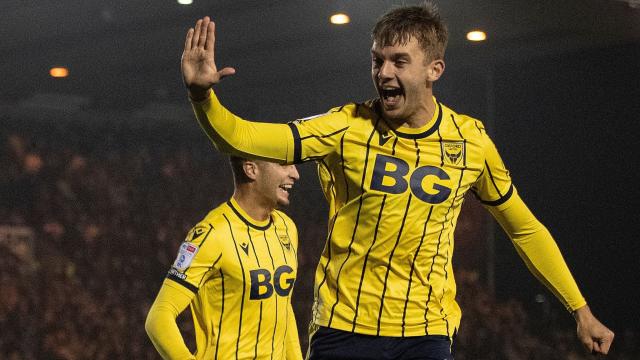
I had a flashback during last night’s game against Lincoln. We had a goal kick taken by Elliott Moore, the ball rolled barely two feet to James Beadle who touched it once and launched it up field.
It made no sense, there was no advantage to Beadle simply taking the kick himself. In fact, it created a small disadvantage because, should the ball come straight back, Moore was standing in the six yard box playing everyone onside.
It reminded me of one of our early encounters with League One Extreme Playing From The Back (LOEPFTB). It was February 2021 away at MK Dons during lockdown, I commented on it at the time, it was almost obsessive and regularly got them into trouble. In December of that year, under Liam Manning they did it again, Nathan Holland stole in to harry a dawdling keeper and Mark Sykes scored the winner at Stadium MK. Fast forward to April 2022 and they’re at it again, rolling the ball around the back line until Billy Bodin nicked in to score a last minute winner which also marked Karl Robinson’s final peak before the rot set in. Those two moments effectively cost Manning promotion to the Championship.
So, it seems I was aware of Liam Manning before I was conscious of Liam Manning. It was interesting last night that, following the injury to Sam Long and the switch to a conventional back-four, we seemed generally more comfortable. That wasn’t the only thing of course, the return of Cameron Brannagan shared the load with Marcus McGuane in midfield and the energy of Stan Mills and Tyler Goodrham meant we retained a higher pace than at other times this season.
But, LOEPFTB was still evident as the ball was regularly played along the back line and back again while Lincoln worked hard to close everything down and force mistakes. Their high pressing game, when stripped of too much LOEPFTB, is almost becoming the modern day equivalent of route one football and is clearly a growing favourite amongst teams at our level. It relies on fitness and organisation over technique and is designed to crush creativity. If you’re a mid-ranking side with limited funds, it makes sense to invest in these controllables over mercurial talent.
In the early stages we played the ball around while Lincoln buzzed about trying to catch a loose ball or two. It worked a couple of times and Beadle did well to stop them capitalising. Being caught out from time to time seems to be priced into our chosen style, but it still feels a bit loose.
The opening goal, though, was a much simpler affair – quality ball into the box from Brannagan, strong header from Cairon Brown, 1-0. It was nearly two when Tyler Goodrham drove from outside the box. We put the game to bed when Stan Mills charged down the wing and fired in a cross, forcing the keeper to parry into his own net.
In the closing minutes, with the game safe, Gatlin O’Donkor decided, uncharacteristically, to have a shot from range. For those who accuse O’Donkor of appearing disinterested, it was good to see him speculate a little. According to Jerome Sale, Liam Manning didn’t look impressed because it wasn’t in the style he wanted, but that ignores that the game was won by similar moments of simplicity.
Purists will argue, probably rightly, that LOEPFTB is a proven way of creating those chances, it stretches teams, tires them out, stops them from establishing an attacking threat and forces them into mistakes. It’s all a platform for putting your laces through it or getting your noggin on a cross and sticking it in the net. We have been less willing to do that in recent weeks, but you can see what benefit it had against Lincoln.
As we’ve seen a couple of times this season, it can sometimes seem like we’re trying to unlock teams when the door is already open. Our inherent ability can be equally effective as our tactical sophistication. Our best performances – Barnsley, Derby – have come when we haven’t been allowed to be quite so cerebral, or last night, when Sam Long’s injury forced a pragmatic response.
In 2010, Chris Wilder abandoned his attacking trio of Midson, Green and Constable in favour of Franny Green and John Grant mid-season, causing a dip in form which he eventually rectified by reinstating the original trio. Equally, in 2016, Michael Appleton struggled to squeeze Danny Hylton into his ideological framework, but Hylton’s ability to deliver regardless meant he maintained a presence throughout the season. Both season’s were successful, but they did require an adjustment to the managers’ tactical indulgences.
This was a excellent demonstration of football’s simpler virtues and let’s not forget a) we won, b) we’re second and c) this is one of the best starts we’ve ever had. It may also be exactly what Manning thinks – we need to be more clinical taking chances. But it teaches us something about not becoming too dedicated to ideology because it can derail the best teams. A reminder not to over-complicate or over-strategise; football is a simple game.
 Oxblogger
Leave a comment