In Jon Ronson’s book The Dead Scrolls, he mentions some research which said that one of the key characteristics of a leader is not their technical mastery, but whether they talk a lot. Apparently if you talk a lot, regardless of what it’s about, you are more likely to get promoted.
As I get older, I begin to realise that in most walks of life, those who achieve the most are often those who play the game right, talking a lot is clearly part of that.
In fact, I tend to find that those who really know their stuff are at the next level down – they have technical competence, but they’re more thoughtful and considerate, less talky. If anything, they prefer not to be embroiled in a game for career improvement which can be incredibly consuming and not that much more rewarding.
Some argued that one of the reasons for our failings this season is the loss of John Mousinho as a calming counter-balance to Karl Robinson. Mousinho’s departure, and presumably for a period before that, left the club in the hands of a man whose primary leadership tool was the noises he made.
I’m not suggesting Robinson had no technical ability, far from it, but it was sometimes hard to access that when he spoke so much. If he was under pressure, he spoke more, which fogged his technical mastery.
I wonder whether Mousinho was a counter-balance, he’s clearly a smart guy and level headed, but perhaps Oxford became a place where he could first transition away from playing into coaching, and then develop his managerial skills. To Robinson, it felt like Mousinho was additional capacity rather than an alternative viewpoint. Once Mousinho realised that he’d learnt all he could, it was time to move on.
The move to Portsmouth was probably quite fortuitous; it’s a big club to start your career with. Most League 1 managerial debutantes nowadays seem to come down the Liam Manning path via Premier League academies.
You can’t begrudge the fact he took the opportunity when it was presented to him. In a sense, though, it puts him back on the bottom rung. When Mark Lawrenson moved from being a Liverpool player to Oxford boss in 1988, he was so overwhelmed by the responsibility, despite the apparent climbdown in terms of the stature of the club he was working for, he asked Maurice Evans to stay in the same office as him. You don’t get the sense that Mousinho is quite in that realm, but being a leader might be more challenging than he imagines.
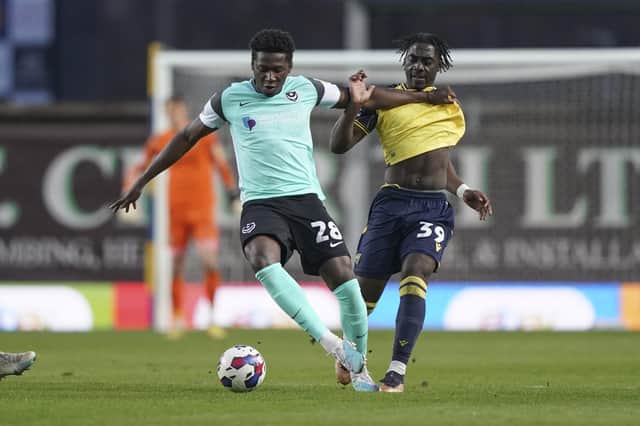
There were periods last night when it felt like we were watching two teams who were being led by coaches who’d been on the same training course. Early in the second half there was a passage which looked like some kind of AI reinterpretation of a game of football – looking both real and unreal at the same time. Both teams played out from the back, both pressed hard, then possession was handed over and it started again. Neither provided much penetration or inspiration to make an impression on the game.
Before that, two set-piece goals, the kind of risk/reward ratio that new manager’s can get on board with. Their goal was top quality, no arguments there, ours not without merit, although it did feel like Sam Long was a bit surprised to find himself where he was to head it in.
But, despite Pompey fans mocking us for the fact that John Mousinho had chosen to make the switch, midway through the second-half they had clearly become frustrated with their sanitised textbook approach to the game. It’s rare you hear away fans in the North Stand berating their team quite so clearly.
By contrast we were looking increasingly menacing, as if Manning had flicked to the end of coaching manual and found that shape and discipline might stop you losing, but it takes something inspirational to win. There’s a point where the team needs reach beyond technical improvements.
You can see this evolution most in Gatlin O’Donkor, whose development this season has been fascinating. He’s got physically stronger, then faster, then more aggressive and now half chances are being gradually turned into full chances. The next step is to put the ball in the back of the net.
He’s not there yet, you can’t help but think that Matt Taylor’s deeper muscle memory may have seen a breakthrough. He had those marginal movements that turned chances into goals; quicker anticipation, a half-step to the side, a little more composure, a fraction more guile. I doubt Taylor would have returned twenty goals this season, but a couple could have made all the difference.
O’Donkor’s got time, but for the team, while the signs continue to be encouraging, we are still being chased by the creeping death of relegation. It’s like a video game where we have to keep moving forward before we get gobbled up by some marauding beasts. Can we evolve fast enough to win a game or will the beast consume us before we do? We’re close, it now seems the prophecies were right; this season will come down to a three game shootout against Cheltenham, Forest Green and Accrington. After last night, we can still live in hope that the incremental gains we’re seeing each week will finally pay dividends and secure our safety.
 Oxblogger
Leave a comment