
They say that life is a boring story which ends badly. You could say much the same about football managers – perhaps a story of abuse which ends badly. Given that nearly every managerial reign ends under a cloud, you have to wonder why anyone would ever want to do it.
Firstly, you must be of a certain mindset, that despite an endless stream of people questioning every decision, you’re able to develop an unerring sense of self-belief. That thick skin might serve you well in deflecting criticism, but it’ll also deflect any offer of help, constructive thought or objective advice.
Karl Robinson has admitted to being addicted to football management; whether it’s gambling or iPhone games, any addict will tell you that it’s the belief that your next win is just around the corner that drives you onto the next game. You hate yourself for it, but it’s what drives you on to have one more try. The thick skin you’ve developed stops any logic and perspective from seeping in.
As the crisis against Cambridge unfolded, I created a graph to show the rolling forty-six game points total for the club over the last ten years. Karl Robinson claims he’s been in worse positions than the one he’s been in before, that’s true, in his earliest days, the forty-six game total bubbled under 50 points, it took him a season to recover to the point he’s at currently – fifty-six.
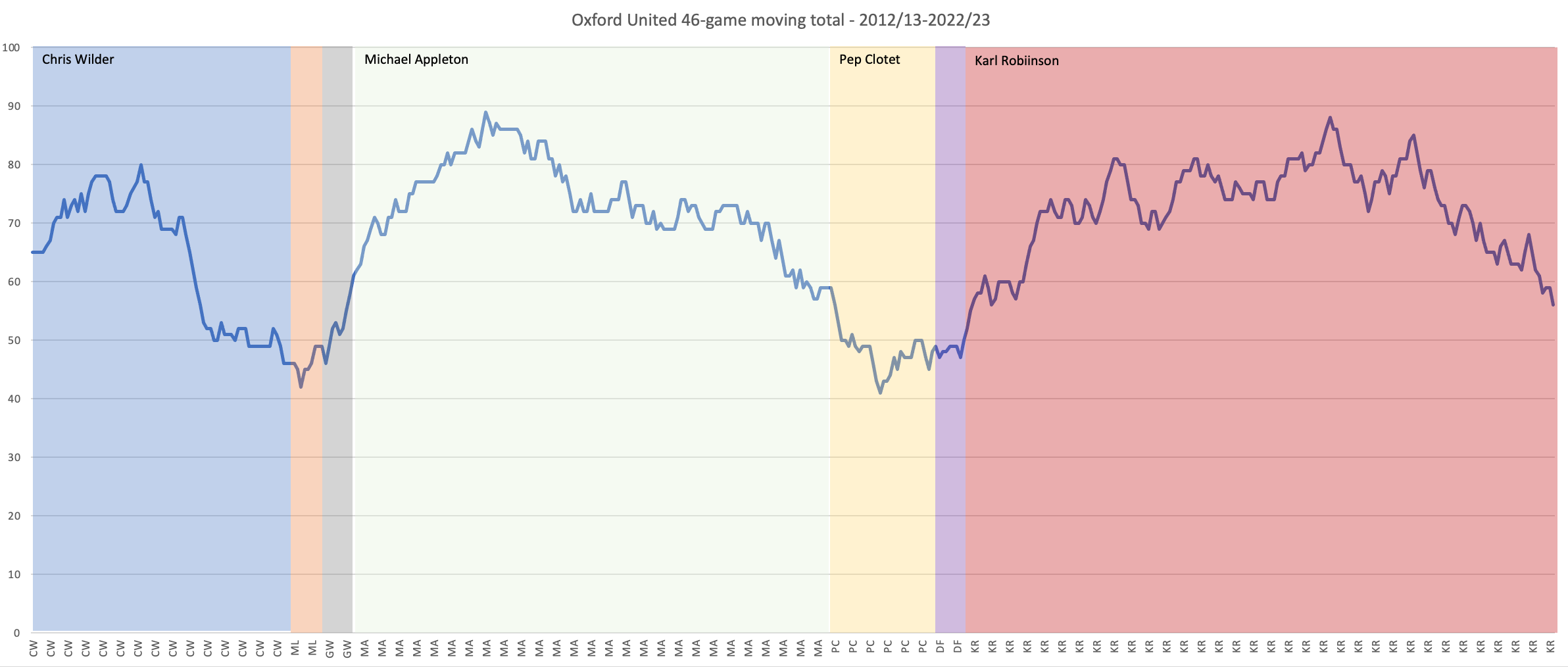
But he’s also been on a gradual slide for the best part of a season, at one-point last year he’d peaked at eighty-eight points, but it’s been downhill ever since. Even if we’d beaten Burton, MK Dons and Cambridge, we’d still be only on 61 points for the previous forty-six games. The graph would have looked better, but not much.
I’m not great with absolutes; to have complete confidence that Karl Robinson should go and to ‘know’ the reasons why leaves a nagging doubt in the back of my mind that I could be wrong. All decisions come with risk, we may get a new manager bounce, we could have a period of extended hiatus as we did after Chris Wilder and Pep Clotet.
In Karl Robinson’s head, he could look at the graph and point to the recovery he achieved post-Clotet as proof that he knows how to get out of this hole. I’d go as far as saying he probably does know how to get out of it from a purely technical, managerial perspective, but I’m much less sure that he can do it at this club.
For the players and staff, there must be a point where the same voice saying the same thing becomes less and less effective. Where the bits which grate, become intolerable. Where, for your own mental wellbeing, you shut off. A dressing down about standards, once something which penetrated deep into your self-worth, is just someone ranting. It’s not so much losing the dressing room, more a modifying of behaviour for the sake of a quieter life. Like living with a teenager, you eventually tolerate the hygiene issues, the sleeping in until 2pm and the grunting, because it’s mildly preferable to killing them in cold blood.
One thing the graph shows is that once managers are on the decline they don’t recover, in many cases, particularly at other clubs, that’s because they aren’t given the chance. But for us, our last two long term managerial departures – Chris Wilder and Michael Appleton – were the choosing of the managers themselves. Wilder moved to Northampton when things at Oxford became dysfunctional, money became less available and the shine he’d achieved with promotion started to dim. Michael Appleton admitted at the end of the 2016/17 season that he was tired and drained, his points haul was sliding at the time. He, perhaps, sensed that he’d struggle to produce another John Lundstram or Ryan Ledson to keep things moving forward. As soon as an opportunity came to move, he did.
Both, presumably, believed they had the ability – neither seemed to lack self-belief – but they also had the wherewithal to spot that they and their environment were becoming incompatible.
Karl Robinson doesn’t have another job to go to, as far as we know, his addiction is deep, perhaps deeper than any manager we’ve ever had. He will want to put it right, but I think he’ll find it harder and harder to do. It might sound like a bad excuse for breaking up with your partner, but it’s not just about him, it’s about us too.
We’re now on our worst run for over twenty-two years, this tells us one thing, at least – these sequences will eventually break, even the worst teams win eventually. Next week we’re at home to Bristol Rovers who are on a similarly bad run of form. If Robinson does survive the week, then surely that game is do or die for his future.
 Oxblogger
Leave a comment