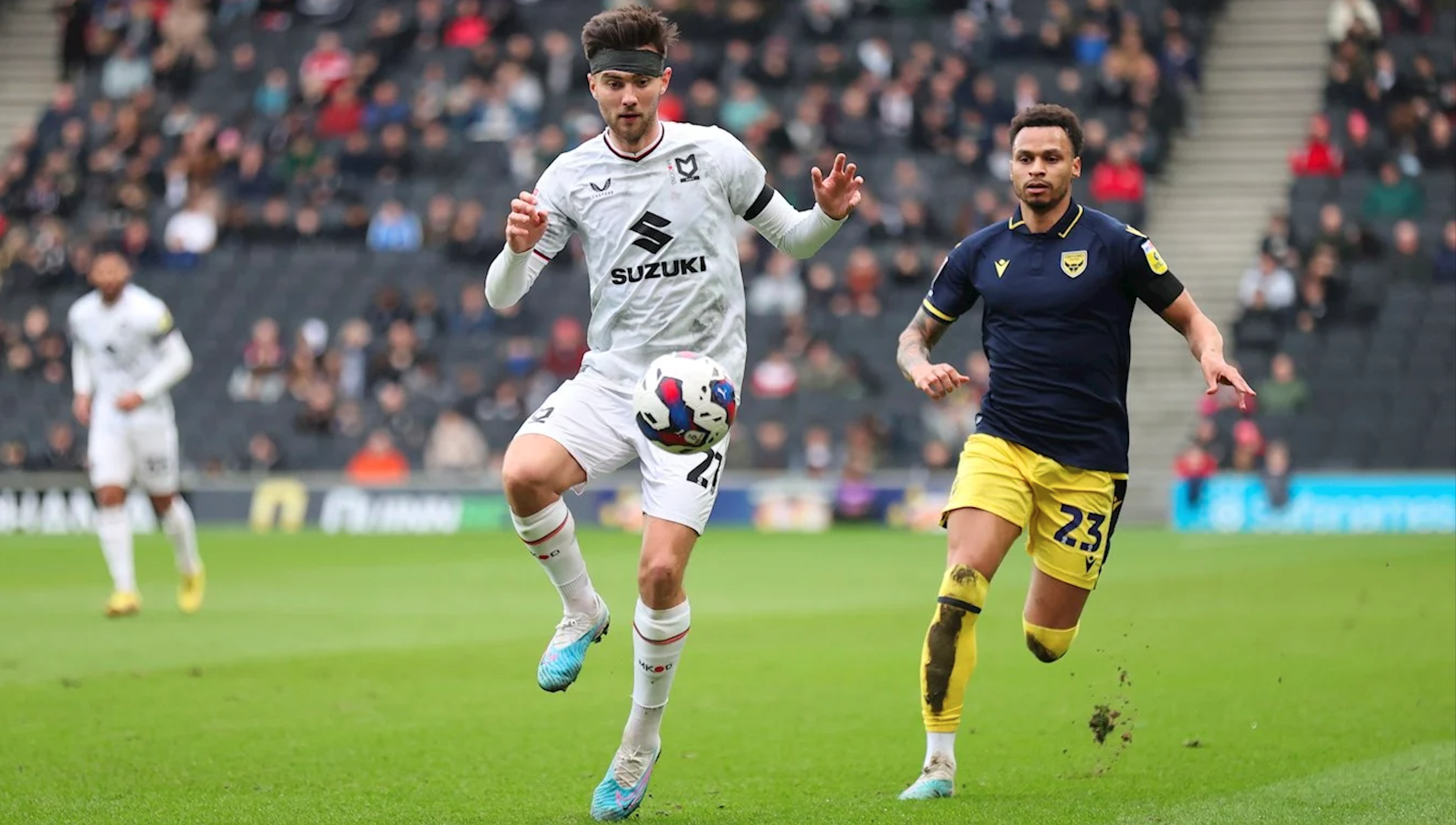
“Why” said the twelve-year-old in transit with us to Milton Keynes on Saturday “Do MK Dons have such a big stadium when play in League One?”
It struck me that to a growing number of people, MK’s shameful back-story is ancient history, no more vivid and real than our Milk Cup win. They’re not a pariah, as just another club in the division, only the idiosyncratic Stadium MK giving away any hint of their strange history.
At what point do we declare that the MK Dons experiment has failed? Some fans are still engaged in an ongoing fight against their legitimacy, complaining as if it’s a project still in progress. If the stadium is a statement of their ambition, the number of people in it each week indicate how close they are to achieving that. To that end; not very. They’re not on a journey, this is who they are.
The stadium is the most divorced dad, driving rock classics on CD, BMW Five Series stadium in the country. The seats, all in threatening macho black, they have commendable upholstery which you can bore people about, dead-eyed kids who want to be somewhere else wave flags when the teams come onto the pitch. For every corner, the scoreboards repeat the same dad-joke ‘Yokohama Tyres – Great at Corners’. Even the sponsorships are trad-dad specials – Suzuki, Yokohama, Marshall amps, Korg instruments. In the dead of night, you can probably hear it cry itself to sleep.
There’s a banner in the top tier with the legend, ‘We’re the light that never went out.’ It’s a reference to what? Their struggle? They’re football’s Brexit, an idea they championed whose evident struggle is now everyone else’s fault.
Their lack of soul was never going to be improved by our lack of heart. Recent weeks have felt like we’re driving an articulated truck down a cul-de-sac; a hopeless, helpless mess from which we couldn’t escape. Fittingly, the first half was despairingly bad, I don’t know if we’re a particularly small team or League One has developed a preference for squads full of hulking players, but we were over-run with their direct running and brute strength. Thankfully, they lacked finesse to create any end product. The bloke behind me, quoting Noel Coward I believe, summed it up when he hollered; ‘That’s shit you fucking cunt.’
Even before the goal there were plenty of warnings, at one point, MK broke down our left into a gaping space. As they advanced towards the box, in midfield, Brandon Fleming, whose station was being raided, jogged back towards the play seemingly unconcerned. It was as if he had a premonition about the outcome or he just assumed someone else would sort it out. There was no sense of responsibility; like a teenager leaving dirty bowls of cereal in the bedroom, assuming someone else will wash them up.
When the inevitable goal came, it was an identikit low drive past Simon Eastwood. I know nothing about goalkeeping and can only assume he’s had one of his arms shortened, we seem to concede the same goal every week. In response we offered no threat up front, no fight in the middle, no responsibility anywhere on the pitch.
It’s this responsibility that’s lacking; teams can gain territory collectively, but it usually takes something individual to score goals. Somebody needs to assume ownership, take a risk, break a pattern to wrong-foot the opposition – it might be a pass that switches the play, a run that breaks a formation or simply the gumption to take a shot.
These moves usually fail, so it takes confidence to even try and a trust that you won’t be criticised for doing it. I’m not suggesting the team don’t trust each other, but there’s no collective confidence, no go-to player who others can turn to to make a difference. A goal, let alone a win, felt beyond us.
The problem with this team now is that many of them know little better. There isn’t the corporate memory of how this team works, no model to fall back on, no ownership. Players need to look at themselves and realise the solution lives amongst them.
McGuane’s introduction at half-time in place of the breathtakingly ineffective Murphy added muscle and purpose in midfield. His presence helped unlock Bate and Goodrham; suddenly we seemed to have forward momentum, some hope.
Goodrham, at least, has the capital that comes from being homegrown, he will probe and harry, but it’s asking a lot to expect him to ask to carry a whole team devoid of confidence. None-the-less, it was his tackle which helped open the opportunity for Bate, who feinted and swerved until it became obvious his best option was to shoot. Thank goodness he did.
Confidence returned, we looked more likely to score, more desperate for the three points. You can tell which team is on top by the attitude of the keepers, theirs – ponderous, fussy, slow, Eastwood alert, wanting to get the ball in play. A winner didn’t come, but at least it shifted the mood.
It didn’t quite feel like a pivotal point, but it was important stem the losses and find an identity which will hopefully keep a relegation fight at arms’ length. It feels about all we can hope for now.
 Oxblogger
Leave a comment